
Fentanyl and its analogs are part of the growing opioid crisis in the United States. According to the latest data from the National Survey on Drug Use and Health1 , more than 2.1 million Americans struggle with an opioid use disorder for either prescription pain relievers or heroin. The National Centre for Injury Prevention and Control estimated that the total annual economic burden2 of prescription opioid misuse in the United States is $78.5 billion, which includes increased healthcare costs, substance abuse treatment, lost productivity, and criminal justice. Because of this, both routine clinical and post-mortem toxicology testing demands have rapidly increased. Whole blood is a common choice for sample matrix due to its availability, but the viscosity can make blood a challenge to work with.
This difficulty demonstrates a real need for robust sample preparation methods to extract opioids from dirty biological matrices across many industries, including medicine, workplace testing, and forensics.

Figure 1. Typical ISOLUTE® SLE+.
Analytes
4-ANPP (4-aminophenyl-1-phenethylpiperidine), 4-fluoro- isobutyryl-fentanyl, acryl fentanyl, alfentanil, butyryl fentanyl, carfentanil, fentanyl, furanyl fentanyl, isobutryl fentanyl, methoxyacetyl fentanyl, norfentanyl, o-fluorofentanyl, sufentanil, U-47700, U-51754, valeryl fentanyl
Methods
There are several different extraction methods that can be used to isolate fentanyl compounds from whole blood samples. The simplest technique is supported liquid extraction using ISOLUTE® SLE+. This product, available in 96-well plate or cartridge format, employs the mechanism of a liquid-liquid extraction with a diatomaceous earth sorbent, allowing for complete separation of the aqueous and organic layers (see Figure 1).
The first step is loading samples onto the diatomaceous earth material. A five-minute wait time allows the aqueous sample to fully adsorb onto the sorbent. Next, an elution step follows using a water-immiscible organic solvent like dichloromethane (DCM), ethyl acetate (EA), or MTBE (tert-butyl methyl ether). This step targets the compounds of interest allowing them to elute off of the diatomaceous earth sorbent, while leaving behind any aqueous impurities and other unwanted components.
Table 1: Supported Liquid Extraction (SLE) methodology (ISOLUTE® SLE+ 400 µL plate, p/n 820-0400-P01).
|
Step |
Conditions |
|---|---|
|
Blood sample volume |
100 µL |
|
Pre-treatment |
100 µL 1% NH₄OH (aqueous) |
|
Load sample |
— |
|
Elution |
2 × 750 µL dichloromethane OR |
|
2 × 750 µL ethyl acetate OR |
|
|
2 × 750 µL MTBE |
Following elution, evaporate samples to complete dryness using a Biotage® SPE Dry 96 plate evaporator. Reconstitute in 50 µL 50:50 mobile phase A/mobile phase B.
Solid phase extraction (SPE) can be also be used to isolate the fentanyl compounds. A silica-based sorbent (ISOLUTE® HCX) or a polymeric sorbent (EVOLUTE® EXPRESS CX) can both be used. Each of these options utilize a mixed-mode extraction mechanism (non-polar interactions and cation exchange) to allow for additional sample purification without loss of analyte. The silica-based sorbent requires traditional SPE conditioning and equilibration steps prior to sample loading. These silica-based plates also require longer drying steps before the compounds can be fully eluted from the sorbent. In contrast, the polymeric sorbent is water-wettable, which permits the exclusion of the condition and equilibration steps, and also promotes less pre-elution plate drying time (see Figure 2).
Tables 1 and 2 detail the methods used for the extraction of fentanyl compounds from whole blood. These methods can be processed manually using a Biotage® VacMaster ™ 96 vacuum manifold or a Biotage® PRESSURE+ 96 positive pressure manifold. The extraction can also be automated using the Biotage® Extrahera™ automated sample preparation system.
Table 2: Solid Phase Extraction (SPE) methodologies
|
Step |
ISOLUTE® HCX 25 mg plate (p/n 902-0025-P01) |
EVOLUTE® EXPRESS CX 30 mg plate (p/n 601-0030-PX01) |
|
Blood sample volume |
100 µL |
100 µL |
|
Pre-treatment |
100 µL 0.1% formic acid (aqueous) |
100 µL 0.1% formic acid (aqueous) |
|
Extraction |
||
|
Condition |
1 mL methanol |
NONE |
|
Equilibrate |
1 mL 0.1% formic acid (aq) |
NONE |
|
Load |
200 µL of pre-treated sample |
|
|
Wash 1 |
1 mL water |
1 mL water |
|
Wash 2 |
1 mL 0.1% formic acid (aq) |
1 mL 0.1% formic acid (aq) |
|
Wash 3 |
1 mL methanol |
1 mL methanol |
|
Plate Dry |
10 min at 20 psi |
1 min at 20 psi |
|
Elution |
2 x 750 µL 78:20:2 DCM/IPA/NH4OH OR |
2 x 750 µL 78:20:2 DCM/IPA/NH4OH OR |
|
|
2 x 750 µL 78:20:2 EA/ACN/NH4OH |
2 x 750 µL 78:20:2 EA/ACN/NH4OH |
After elution, evaporate samples to complete dryness using a Biotage® SPE Dry 96 plate evaporator. Reconstitute in 50 µL 50:50 (v/v) mobile phase A/mobile phase B.

Figure 2. Typical workflow for solid phase extraction using EVOLUTE® EXPRESS
LC parameters
Instrument
Shimadzu Nexera X2
LC cartridge
Restek Raptor Biphenyl 100 x 2.1 mm, 2.7 µm (Cat # 9309A12)
Cartridge temperature
40 °C
Mobile phase A
0.1% formic acid in water
Mobile phase B
0.1% formic acid in methanol
Isocratic Flow
50:50 Mobile Phase A/Mobile Phase B
Flow rate
0.4 mL/min
Run time
7.00 minute
Injection
2 µL
MS/MS parameters
Instrument
SCIEX 5500 Triple Quadrupole
Source gas
600 °C
Curtain gas
20
Collision gas (CAD)
8
Ionspray voltage
4000
Ion source gas 1
30
Ion source gas 2
60
Positive polarity
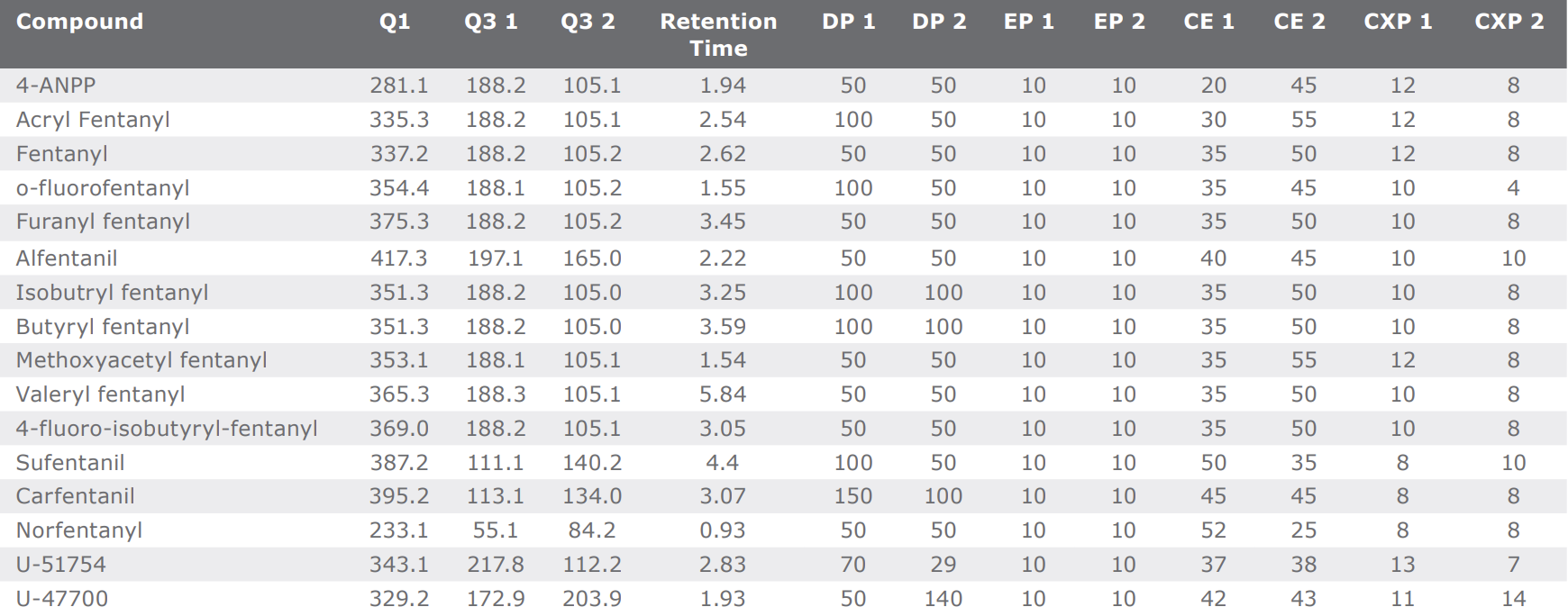
Table 3 shows the MS parameters for each compound in the panel.
Table 3: MS Parameters for all fentanyl compounds.
Results
For every method, LOQs were established down to 0.1 ng/mL for all compounds in the panel. The recoveries and matrix effects shown are using a 0.1 ng/mL sample in whole blood. Overall, recoveries using EVOLUTE® EXPRESS CX and a DCM/IPA/NH4OH elution solvent were higher than the other methods assessed (Figure 3). However, increased signal suppression was evident in the DCM/IPA/NH4OH elution solvent with the EVOLUTE EXPRESS CX data set. The lowest recoveries were seen using ISOLUTE® SLE+ with a DCM elution solvent, but were still above 50% for all compounds in the panel. Using ISOLUTE HCX with the EA/ACN/NH4OH elution solvent demonstrated the least amount of matrix effects (Figure 4). The most suppression was found when either the ISOLUTE HCX or EVOLUTE EXPRESS CX methods were paired with the DCM/IPA/NH4OH elution solvent. Suppression with these methods ranged from 10–40%.
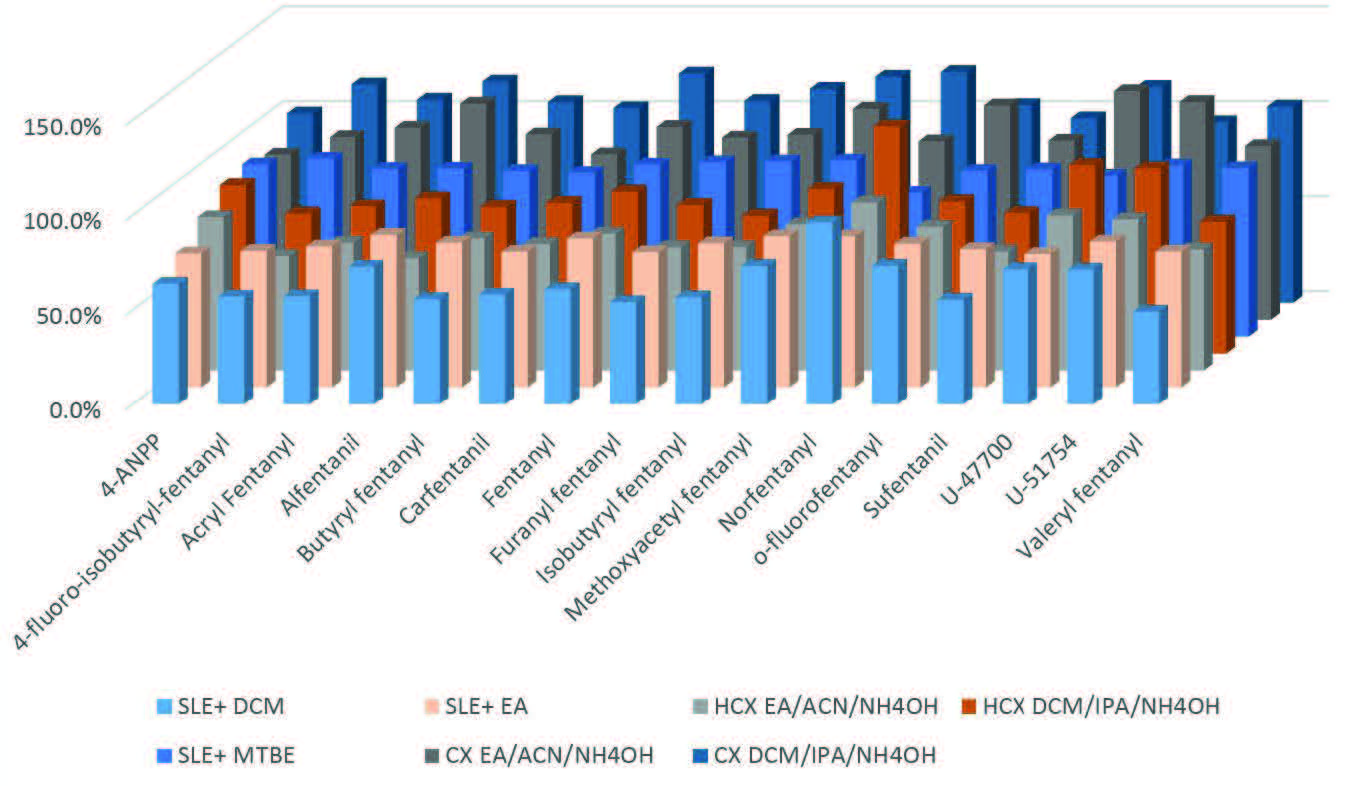
Figure 3. Recoveries of Fentanyl compounds using various extraction techniques and elution solvents.

Figure 4. Matrix effect for Fentanyl compounds using various extraction techniques and elution solvents
Conclusion
There are several different extraction techniques that can be used to extract fentanyl compounds from whole blood samples. It is important to consider the compounds in the
panel, the desired extract cleanliness, compound recoveries, and extraction time to determine which method best fits the application. If using ISOLUTE SLE+, an elution with MTBE has the highest recoveries and fewest matrix effects. If using ISOLUTE HCX or EVOLUTE EXPRESS CX, an elution solvent of DCM/IPA/NH4OH has the highest recoveries, but slightly increased matrix effects.
References
- https://nsduhweb.rti.org/respweb/homepage.cfm
- Med Care. 2016 Oct;54(10):901-6. The Economic Burden of Prescription Opioid Overdose, Abuse, and Dependence in the United States, 2013
Literature number: PPS546
