
Introduction
It is imperative that pharmaceutical processes have the flexibility and robustness to quickly output targets of interest – from small molecules and APIs for drug products to complex structures or chemical sensors that may be used in kits or other diagnostic devices. In chemical manufacturing, for example in the pharmaceutical industry, target molecules are synthesized on a large scale in dedicated manufacturing plants. Such processes represent the culmination of a great deal of research and development, where much time and consideration has been spent scaling laboratory based synthetic routes into commercially and practically viable manufacturing procedures. This paper explains the principles of scale up purification.
The synthetic route taken to reach a target molecule is only half of the story. At the end of each chemical transformation, there is still the same requirement for purification and clean up procedures in order to ensure purity criteria for delivery to the next stage are met. Molecules of interest may be isolated from complex reaction mixtures containing starting materials, catalysts, solvents, products and by-products. Isolating desired molecules while eliminating the undesired is in many ways one of the most challenging aspects of synthetic chemistry.
In the laboratory, chromatography is a reliable, robust and much used methodology for purifying target molecules. Indeed, flash chromatography has become the go-to option for post- reaction purification in chemical research. However, in a scale up production environment there has been a reticence to deploy chromatography for a variety of reasons. This white paper discusses the challenges in employing chromatography in the manufacturing plant, and presents a practical, scalable and commercially viable approach to chromatographic purification in a chemical production environment.
The need for large-scale chromatographic purification
The process development chemist is adept at optimizing methods and routes created in a medicinal chemistry environment, often under the constraints of time pressure, with a focus on getting enough material through for chemical testing or the next stage of evaluation. The tools they have at their disposal are grounded in a deep-rooted understanding of the principles of scale up technology and process economics. In cases where traditional methods may struggle to remove components that have been identified as undesirable, niche, labour intensive or other inefficient methods often prevail.
To produce enough product for clinical trials, there is usually a wide gamut of techniques available, but these options narrow as scale increases and processes are expected to yield more.
At the cusp of this dilemma has been purification. The recent trends in pharma to produce ‘enough’ for clinical testing, in tune with the age-old paradigm of “fail early, fail fast” has resulted in a greater number of unoptimized medicinal chemistry methods moving more directly into development programs.
Later down the line, engineering out undesirable steps is always a possibility, but this is often an expensive and time-consuming approach to process scale up. A better approach is to develop more robust purification steps as part of the manufacturing process from the start. Products can be isolated from chemical reactions in many ways, with differing levels of complexity.
For example, if the final product separates in some manner from the reaction mixture (perhaps as a biphasic mixture or more commonly as a solid precipitant), then simple physical manipulation may be used to remove the desired material from the reaction at a high degree of purity. In other cases, recrystallization may be required, typically through use of another solvent. Recrystallisation is time-consuming but effective and requires only physical manipulation. However, things become far more difficult if physical techniques such as recrystallization or precipitation are not feasible. Then it is quite likely that another purification methodology will be required.
Complexities of large-scale chromatographic purifications
Large-scale chromatography to purify products is a complex undertaking. Although purification by chromatography in flash experiments is commonplace in the laboratory, trivial procedures on a small-scale become much more complex when performed on larger scales. We can understand the complexities involved by considering the nature of chromatography. Chemically, and fundamentally, large-scale purification chromatography is identical to lab scale purification, however the added chemical engineering considerations can make the logistics of implementation more complex. But for those working in the industry, these complexities are part and parcel of the trials of daily life.
In a typical liquid chromatography experiment, a solvent (the mobile phase) is pumped through a stationary phase, typically silica, which is present as small particles either irregular or spherical in shape. The sample is introduced to the flow and moves forward with the mobile phase. During this passage, components of the sample are more retained compared to the solvent front, according to the degree of interaction they have with the stationary phase in the column. When the components are eluted from the column, they do so at different times based on partitioning between the mobile and stationary phases, and the desired product is thus isolated and can be collected.
So what challenges does chromatography bring to the chemical manufacturing environment?
- Solvents – to achieve chromatographic separation, solvent is pumped through a column containing the stationary phase. As the purification is scaled up, so the quantity of solvent required increases, and so the matter of removal of solvent/waste. To perform liquid chromatography, a manufacturing plant must
be able to pump at pressure large volumes of solvent and dispose of the solvent after the procedure. - Media –in traditional self-packed columns (such as glass or SS columns) operators in the plant must be able to move the large quantities of loose, fine powder that makes up the stationary phase for the separation, and also be able to safety dispose of it afterwards. Contact with contaminated silica is of paramount concern.
- Sample introduction – a method of adding the sample to the top of the column is required, not a trivial matter when the sample could be a large volume of liquid.
- Detectors – a method is required to determine when the compound of interest is eluting from the column.
- Electricity – laboratory-based chromatography systems involve electrical power, something that has to be featured in the local and environmental ATEX risk assessments.
- Process economics – chromatography in a production environment is a technique often burdened with misconceptions of exorbitant price, a bar that has been historically set and levied by commercial prep and large-scale HPLC systems.
A final and perhaps most important complexity is that the chromatography method must be developed to isolate the compound of interest from the reaction mixture. Method development in chromatography is not straightforward, and scaling methods can be challenging without the correct scaling tools. As such, scale-up purification relies on good method development procedures and a robustness in method design.
Given the complexities above, it is clear to see why chromatography in a manufacturing environment can be considered challenging. Typically, plant engineers have approached chromatography with bespoke solutions of their own design.
Bespoke liquid chromatography systems in the manufacturing environment
Many chemical engineers design bespoke chromatography solutions for their particular processes. The advantage of such an approach is that the chromatography solutions can be designed with the specific process in mind, and the chemical engineer as the designer fully understands the process so robust production SOPs can be created. However, there can be considerable drawbacks to the bespoke approach.
- The engineer needs to come up with protocols and methods to mitigate the difficulties with large-scale chromatography outlined previously, and they
may have no experience in these areas. - Support of the chromatography solution is dependent on the chemical engineer who designed it, so in the case of difficulties there is no external provider who can assist.
- Bespoke solutions that work well for one process may not be suitable for another, which makes future proofing difficult.
For this reason, bespoke solutions although appealing in the short term may be not sustainable in the long term. Instead, increasingly there is a demand for an ‘off the shelf’ solution.
‘Off the shelf’ large-scale purification chromatography
Alternatively, large-scale flash purification may be performed on dedicated and specifically designed ‘off the shelf’ chromatography equipment from a supplier such as Biotage. This offers several advantages over bespoke in-house solutions:
- The system is designed to fit into a ‘family’ of instruments with common media types, meaning that scale up processes are simpler and more robust.
- Designed specifically for the manufacturing environment, so for example ATEX explosion-proof rating is designed into the system, as is ways of pumping solvent and handling the stationary phase media.
- Expertise in implementing such a solution is provided by the supplier.
- Service support is assured, so that expensive system downtime is minimized.
- Silica stationary phases are supplied in pre-assembled columns, for easy storage, use and disposal.
This makes for a much more commercially viable solution with long-term support.
Biotage flash chromatography solutions – a scalable and practical approach
To address the requirements of chemical manufacturing, Biotage has developed a scalable chromatographic approach to large-scale purification based on flash chromatography. Scalable means being able to take methodologies developed in the laboratory and convert them into large-scale methods, and practical means being able to address or circumvent the difficulties associated with large-scale chromatography in a
production environment. The Biotage approach is based around flash purification, a simple, chromatographic technique that is robust, fast and reliable. Flash can be performed in normal or reverse phase, with normal phase chromatography typically employed to purify organic-soluble compounds, intermediates in synthesis routes, and reverse phase often employed at the end of the synthesis to isolate the final water-soluble drug molecule. A schematic of the normal phase flash purification is shown in figure 1.
The workflow of the Biotage flash purification approach to large-scale purification is discussed below.
Flash purification
Flash purification employs a liquid chromatographic technique, which can be characterized as follows:
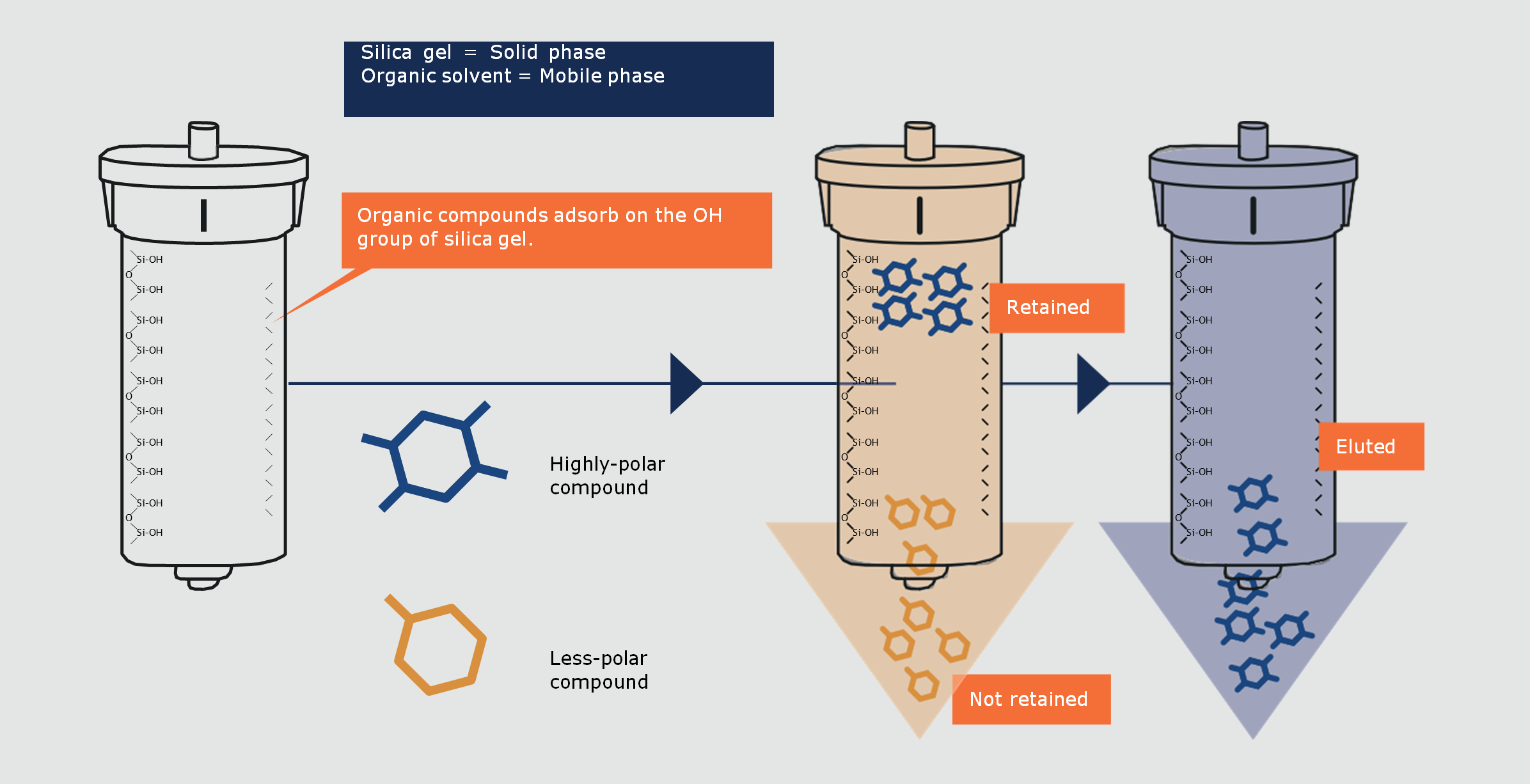
Figure 1. Normal phase flash purification separation mechanism.
Focus on the loading (i.e. sample throughput) of the chromatography rather than the peak capacity – this makes flash ideally suited to purification of mixtures containing
a relatively few components, such as reaction mixtures.
- Medium pressure (lower than traditional HPLC) – this makes system requirements less rigorous and puts the focus on ease of use and robustness over resolution.
- Low cost chromatography – important with large-scale purifications where a lot of media and associated solvents etc. are employed.
Flash chromatography is the preferred purification technique of the organic chemist, and those involved in extracting compounds from natural products. This is because it has
the power to separate a broad variety of compounds more efficiently than other crude purification techniques such as crashing out of solution or liquid-liquid extraction. To deliver pure compounds, chemists can manipulate a large variety of variables to accomplish the desired level of purity. At the same time, flash chromatography is relatively easy to perform an insensitive to minor changes in conditions, making method development simple and robust purifications commonplace.
For these reasons, flash is ideally suited to large-scale purifications.
Flash method development
It is neither practical nor cost efficient to perform method development of chromatography on a large-scale. The solvent requirements alone would be cost prohibitive. Instead, a laboratory-scale set up is used to develop a robust and scalable methodology that can then be applied to manufacturing. The Biotage approach to this is to use Isolera™, Isolera™ LS (larger scale) or Biotage® Selekt flash purification system for the laboratory development. This has several notable advantages:
- Flash purifications are simple and robust, and are well known in the organic synthesis laboratory for purifying compounds and intermediates.
- Flash purifications are often developed looking at chromatography in terms of column volume or CV rather than retention time or retention volume. This makes scaling up far easier, as methods remain the same in terms of composition only the value of the column volume shifts as larger columns are employed. This direct scalability of flash is perfect when developing large-scale purifications. A typical flash purification run is shown in figure 2.
- The Biotage® Selekt system is fast and efficient with an easy user interface, rapid run times and small space requirement, making it perfect for method development in the laboratory.
The Selekt flash purification system (Figure 3) has been developed to perform laboratory scale flash experiments quickly and efficiently. High flow rates, column equilibration times and method development tools mean that users achieve results very quickly, and method development is fast and simple.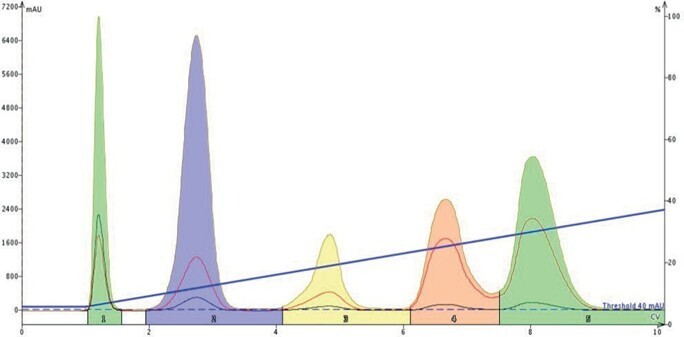
Figure 2. A typical flash purification run with column volume (CV) on the x-axis.
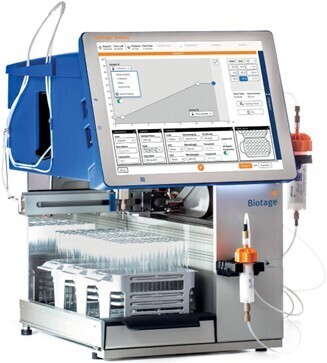
Figure 3. Biotage® Selekt flash chromatography system.
Scaling up flash purifications from the laboratory to the plant
The advantage of flash as a chromatographic method of purification is that it is very simple to scale up between experiments, as the use of column volumes (CVs) as opposed to retention times or volumes means the same method can be applied to different columns. This is illustrated by the scale up table in Figure 4, which shows how the loading achieved at small scale can be used to deter- mine the loading that can be achieved at larger scales using the same separation gradient, with just increased flow rates to compensate for the larger column.
Cartridge scale-up conversion table
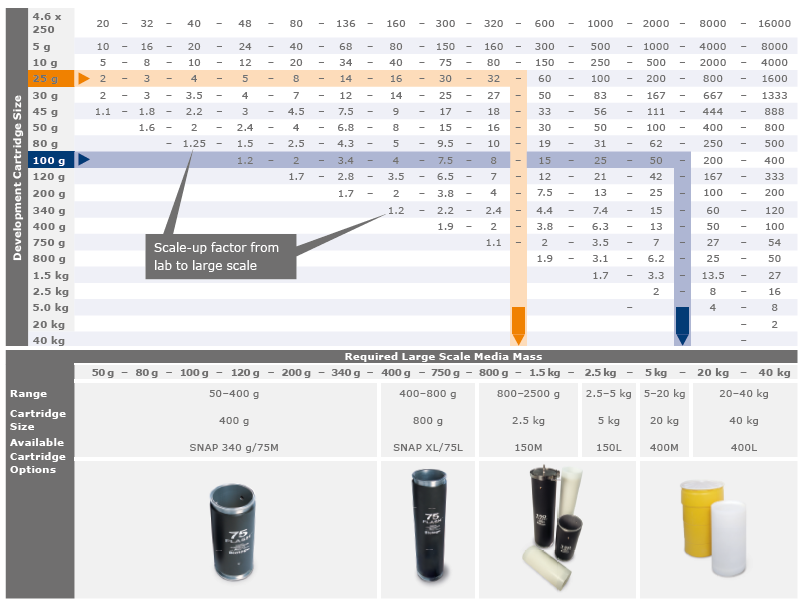
Figure 4. Scaling table for flash chromatography with KP-Sil silica media.
Example 1
A 25 g Biotage® SNAP cartridge was used to develop a 2.3 gram purification. The requirement is now to purify 125 g. The scale- up factor is then 54.3. We therefore move right in the chart on the 25 g row to the interval between 32 and 60. The appropriate large scale cartridge is in the 800–2500 g range, which corresponds to the Biotage® Flash 150M cartridge.
Example 2
A 100 g Biotage® SNAP cartridge was used to develop a 6.5 gram purification. The requirement is now to purify 900 g. The scale-up factor is then 138. We therefore move right in the chart on the 100 g row to the interval between 50 and 200. The appropriate large scale cartridge is in the 5–20 kg range, which corresponds to the Biotage® Flash 400M cartridge.
Along with the scale up table, the flow rate of the new column is scaled on the basis of linear flow velocity, which is an indicator of the speed of the solvent moving through the stationary phase, irrespective of the shape and volume of the column.
This means that the separation will give identical results in terms of elution points (showing separations in terms of column volume or CV) in small and large-scale, and scaling by a factor of ten means that any small deviations can be corrected during the scale up process.
As a result of the preservation of results between scales, it is possible to predict when a substance will elute from a column at large-scale based on the behaviour at the laboratory scale, large-scale UV detectors are also available if required.
Using this simple approach and a laboratory flash system such as Biotage® Selekt, it is possible to develop methods that can be employed with kg sample sizes in a manufacturing environment. What is then required is a system capable of running such a method within the constraints of the plant.
Chromatography in a manufacturing environment
Biotage Flash 75, Biotage Flash 150 and Biotage Flash 400 are large-scale flash purification systems designed for use in the manufacturing environment (Figure 4). In terms of addressing the difficulties of the manufacturing environment, these systems are specifically designed for this purpose:
- Solvents – each system pumps solvent just using compressed gas. Step gradients can be developed that allow the user to adjust elution conditions
to match those created in the laboratory. - Stationary phase – each system makes use of pre-packed columns in a range of media types, so that handling of loose powder is not required for operation, and disposal of used columns is simplified.
- Sample introduction – on the smaller production systems (Flash 75 and Flash 150) the SIMs (sample introduction modules) allow simple introduction of sample to each system in a way mechanically similar to the lab scale development systems simplifying what otherwise could be a difficult and complex step.
- Detectors – scaling up methods developed on Biotage lab scale flash systems such as Selekt and using the same stationary phase means reproducibility in scale-up is high, and predictability of elution is such that it is not necessary to employ detectors during the large-scale run (although systems are available).
- Electricity – removal of electrical pumps and detectors means that the systems require only compressed gas to run, and systems are fully grounded, therefore significantly mitigating against explosion risk in the manufacturing environment.
Large-scale flash chromatography systems from Biotage are specifically designed to take methodologies directly from the laboratory to the manufacturing plant. They are also fully supported by a dedicated service team.
Conclusions
Large-scale chromatography has been seen as a difficult and complex process in the manufacturing environment. However, this need not be the case as long as the right tools are selected and a robust and reliable scale up procedure is employed.
The Biotage approach to large-scale purification in the manufacturing environment is based around a practical, scalable approach to flash chromatography. Methods are developed in the laboratory using dedicated equipment, and the methods are scaled up using a simple scale up procedure based on utilizing the same media and simply scaling up the column size, flow rate and loading appropriately, to generate identical results.
In the Biotage approach, initial purification experiments are performed with a Selekt flash purification system, which allows fast and efficient method development in the laboratory on a small scale. Once the results are optimized, scale up can take place through a simple procedure as the same media is used for the experiments across the scales and the use of column volumes in flash means methods are directly transferable.
In the manufacturing environment, methods developed in the laboratory can then be transferred to large-scale flash systems the Flash 75, 150 or 400. These systems are cGMP compliant with no electronics and so are suitable for use in an explosion risk facility. Three systems operate across the range of purification needs, to allow manufacturing chemists total control over their workflow. Columns are prepacked with media so there is no need to manually move powders, and come with the required certification for use in manufacturing and full service support.
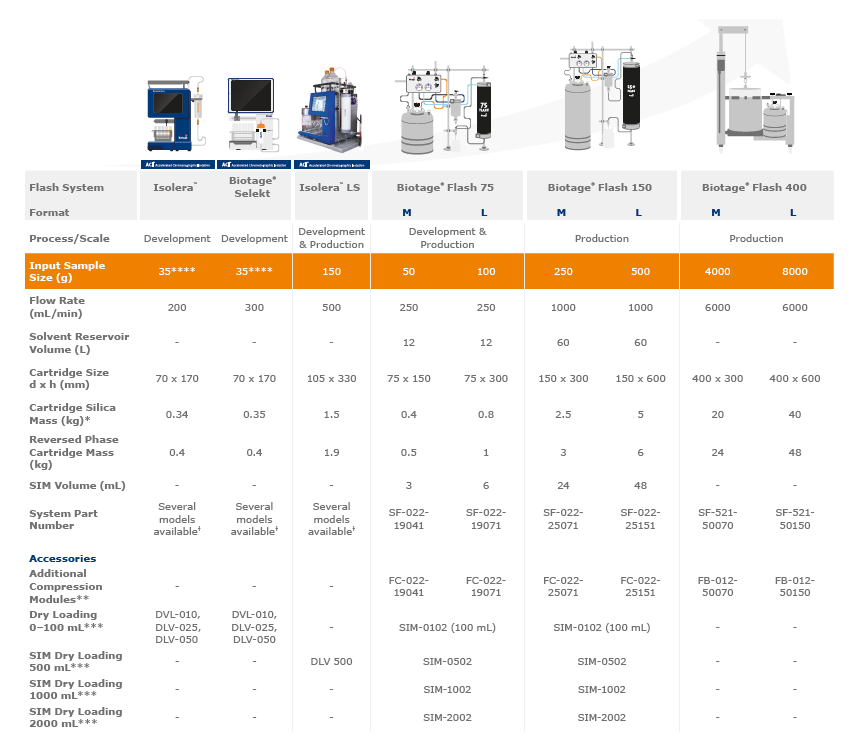
* Based on KP-Sil silica. For HP-Sphere multiply by 1.25
** Additionally available and interchangeable within the M/L format to extend the range of the systems. See ordering information section for more detail.
*** Sample injection modules, additionally available interchangeable units to support increased dry/viscous/poorly soluble sample addition
**** 750 g cartridge also available
† See “Biotage Flash Purification Systems - Pure Compounds in a Flash” (PPS319) or www.biotage.com
Figure 5. Example scale-up path: Biotage chromatography systems, from lab to large-scale (SIM = sample introduction module).
Literature number: PPS58
