
Solid-phase extraction: An analytical technique that continues to evolve
For more than four decades, solid-phase extraction (SPE) has been one of the most widely used sample preparation techniques in analytical laboratories. Whether preparing biological samples for LC-MS/MS, concentrating environmental contaminants from water or cleaning up complex food extracts, SPE has become an essential tool for achieving reliable analytical results.
While analytical instruments have advanced dramatically, sample preparation often receives less attention. Yet increasing sample numbers, lower detection limits and growing pressure to improve laboratory efficiency are driving a new wave of innovation in SPE.
Today, SPE is no longer limited to the traditional cartridge format. Laboratories can choose from a range of SPE extraction formats, from traditional cartridges and multi-well plates to microelution plates and tip-based extraction technologies, each designed to address different analytical challenges. By selecting the most appropriate SPE format for a given application, laboratories can optimize sample throughput, sensitivity, solvent consumption and automation, tailoring workflows to their specific analytical requirements. This article explores how modern SPE formats compare and how to choose the right approach for your workflow.
Advantages of solid-phase extraction
SPE is a sample preparation technique used to isolate analytes of interest from complex matrices while removing unwanted interferences.
The principle is straightforward:
- A liquid sample is loaded onto a sorbent.
- Target analytes and matrix interferences are retained depending on the extraction strategy.
- Unwanted matrix components are washed away.
- The desired compounds are recovered in a clean extract.
SPE is not only an effective technique for sample clean-up but can also be used for a variety of other applications, including trace enrichment, matrix exchange, desalting, fractionation and derivatization workflows.
SPE has many advantages over other sample preparation techniques, such as liquid-liquid extraction (LLE), protein precipitation (PPT) or phospholipid depletion (PLD). These include cleaner extracts and higher reproducibility due to the high selectivity of the technique. Optimizing loading, washing and elution conditions enables highly selective extraction, improving analyte recovery while effectively removing matrix components. Combined with a wide range of sorbent chemistries, SPE can be tailored to a diverse range of analytical applications.
Laboratory efficiency can also be improved by using SPE. Despite the potential increase in preparation steps and method development time required, SPE is a straightforward method for automation, reducing analyst hands-on time and allowing skilled staff to focus on higher-value laboratory activities. Automation also allows for a safer extraction, by minimizing analyst interactions with potentially harmful chemicals. Reducing SPE sorbent mass down to microelution levels further improves laboratory productivity and safety by reducing laboratory solvent usage and waste.
The evolution of solid-phase extraction
Since its introduction in the late 1970s as an alternative to LLE, SPE has continually evolved to meet the changing needs of analytical laboratories. As analytical challenges have become more demanding, additional SPE formats have been developed to improve throughput, sensitivity, solvent consumption and automation, providing laboratories with a wider range of sample preparation options.
How to choose the right solid-phase extraction format
No single SPE format is ideal for every application. The most appropriate choice depends on factors such as sample throughput, sample volume, sensitivity requirements, workflow efficiency and automation goals. Rather than replacing one another, cartridges, well plates, microelution formats and tip-based extraction technologies complement each other and are often used alongside one another within the same laboratory.
Traditional SPE cartridges: Versatile sample preparation
Traditional SPE cartridges remain the foundation of solid phase extraction and continue to be widely used across analytical laboratories. They provide excellent versatility, supporting a wide range of sample volumes, sorbent chemistries and analytical applications, making them well suited to both routine analysis and method development. Cartridges are particularly advantageous for low- to medium-throughput laboratories and for applications requiring larger sample volumes or greater method flexibility.
As sample numbers increase, however, manual processing can become a limitation. In these situations, alternative SPE formats may offer advantages by increasing throughput, reducing manual handling, and supporting automated workflows.
96-well SPE plates: High-throughput sample preparation
For laboratories processing larger numbers of samples, 96-well SPE plates provide a more efficient workflow than individual cartridges. They enable the simultaneous processing of up to 96 samples in a compact format, reducing manual handling, making efficient use of laboratory bench space and increasing sample throughput. Compatible with multichannel pipettes, automated sample preparation systems and LC-MS/MS and GC-MS autosamplers, 96-well SPE plates can be readily integrated into automated workflows, enabling streamlined sample preparation through to analysis while further improving consistency and laboratory productivity.
Microelution SPE: Maximum sensitivity
As analytical methods become more sensitive, laboratories frequently encounter a new challenge, maximizing analyte recovery while minimizing dilution during sample preparation. Microelution SPE addresses this challenge by using a reduced sorbent bed mass than traditional SPE formats. A smaller sorbent bed mass means analytes can be eluted in very low solvent volumes, typically between 20µL and 50µL, while still achieving efficient recovery.
These low elution volumes give concentrated extracts that are often compatible with LC-MS/MS systems, eliminating the need for evaporation and reconstitution. Avoiding an evaporation step shortens sample preparation time and minimizes the risk of analyte loss due to adsorption to the collection vessel, degradation, analyte evaporation or incomplete reconstitution.
These advantages make microelution SPE a favorable option for laboratories working with limited sample volumes and with very low limits of detection (LOD) and limits of quantification (LOQ), such as clinical, forensic and bioanalytical applications.
Tip-based SPE: Fast, automated sample preparation
Not every laboratory challenge requires a packed cartridge or a 96-well plate. Tip-based SPE technologies represent another development in sample preparation, offering an alternative approach for applications requiring rapid processing, low sample volumes and seamless automation.
Rather than passing a sample through a fixed sorbent bed, extraction occurs within a pipette tip containing loosely dispersed sorbent material. The sample is repeatedly aspirated and dispensed through the sorbent, creating highly efficient interaction between analytes and extraction media. This dispersive extraction approach enables equilibrium to be reached within seconds rather than minutes, resulting in rapid extraction while maintaining excellent recovery and reproducibility.
The technology is well suited to low sample volumes and can be performed either manually using standard pipettes or on automated liquid-handling systems. It is fully scalable from 1 to 96 samples, making it suitable for a wide range of batch sizes. As the extraction is driven by pipetting rather than vacuum or positive pressure, there is no need for dedicated SPE processing equipment such as vacuum manifolds, pumps, or compressed air systems.
For many applications, tip-based SPE provides a complementary alternative to traditional cartridge and plate-based formats, particularly where speed, flexibility, low solvent consumption and automation are priorities.
Which SPE format is right for your laboratory?
Selecting the most appropriate SPE format can have a significant impact on analytical performance, laboratory productivity and overall workflow efficiency. One common misconception is that laboratories must choose a single SPE format and use it for every application. In reality, the most successful laboratories select the format that best matches their analytical and workflow requirements. As laboratory needs evolve, it is worth periodically reviewing your sample preparation strategy to ensure you are still using the most appropriate SPE format for your application (Figure 1).
When evaluating your current sample preparation workflow, it is worth asking a few key questions:
- How many samples are processed per day?
- Are sample volumes large or small?
- Is maximum sensitivity required?
- Is evaporation a bottleneck?
- How much analyst time is spent on manual handling?
- Is automation planned for the future?
The answers may point towards traditional cartridges, 96-well plates, microelution formats, tip-based extraction technologies or a combination of several approaches.
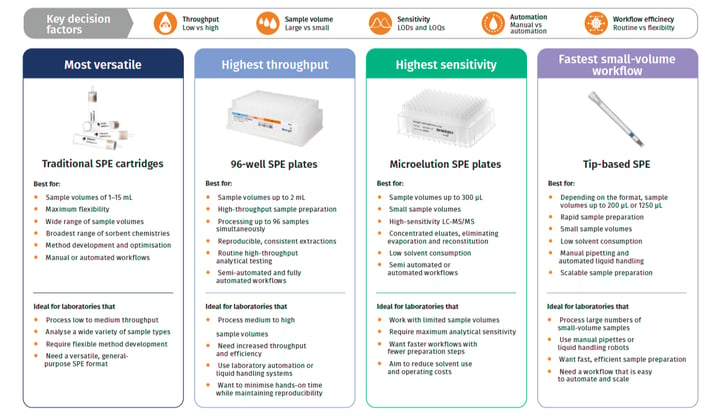 Figure 1. SPE format options considering speed, sensitivity and throughput.
At Biotage, we recognize that no single SPE format is right for every application. As a forward-looking company, we continue to invest in technologies that help laboratories work smarter, faster and more efficiently. From traditional SPE cartridges and 96-well plates to microelution formats, automated sample preparation platforms and innovative tip-based extraction technologies, we support laboratories at every stage of their SPE journey, helping them solve today's challenges while preparing for tomorrow's analytical demands.
Ready to optimize your SPE workflow?
Every laboratory has unique sample preparation challenges. Our experts can help you evaluate your workflow and recommend the most appropriate SPE solution based on your application, throughput and automation goals.
Solid-phase extraction FAQs
What is solid-phase extraction (SPE)?
Solid-phase extraction (SPE) is a sample preparation technique used to isolate target analytes from complex samples while removing unwanted matrix components. It produces cleaner extracts, improves analytical performance and is widely used before LC-MS/MS, GC-MS and other analytical techniques.
What are the advantages of solid-phase extraction?
SPE improves sample clean-up, increases reproducibility and enhances analytical sensitivity. It can also reduce solvent consumption, support automation and improve laboratory efficiency compared with alternative sample preparation techniques.
What SPE formats are available?
Common SPE formats include traditional cartridges, 96-well plates, microelution plates and tip-based extraction technologies. The best choice depends on factors such as sample volume, throughput, sensitivity requirements and automation needs.
When should I use microelution SPE?
Microelution SPE is ideal when working with small sample volumes or when maximum sensitivity is required. Its low elution volumes can often eliminate evaporation and reconstitution steps, simplifying the workflow.
Can solid-phase extraction be automated?
Yes. All Biotage SPE formats can be automated including tip-based SPE. Biotage offers solutions for the automation of cartridges, 96-well plates and micro SPE plates with the use of Biotage® Extrahera™.
