
Recently, the Thorn-Seshold Research Group at Ludwig Maximilian University of Munich (LMU) purchased a Biotage® Selekt flash purification system to help them with their work. Biotage caught up with two of the researchers, Markus Müller and Li Gao, both Ph.D. students, to hear about their experiences with the system.
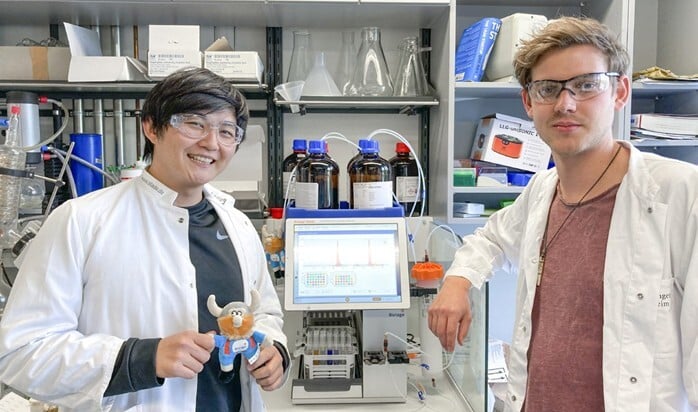
Figure 1: Li Gao and Markus Müller are Ph.D. students at the Thorn-Seshold Research Group at LMU
Tell us about yourselves and your background.
Markus: I started my chemistry career at Boehringer Ingelheim in Biberach with an apprenticeship in medicinal chemistry.
Afterwards I studied chemistry at Ulm University and did my Master at TU Munich, followed by the currently ongoing Ph.D. at LMU. Synthetic chemistry has been my companion all this time, and I have seen many labs with different equipment and working styles.
Li: My background is in organic and medicinal chemistry. I obtained my M.Sc. at LMU Munich, with research stays at Kyoto University and Bayer Healthcare. During my master’s thesis at LMU, I was working on semi-synthetic natural product photo switches in the group of Prof. Dirk Trauner (now at NYU).
I have continued my work in the field of photo pharmacology after joining the Thorn-Seshold group, where I am transitioning towards chemical biology. This requires a broad understanding of chemical synthesis, UV/Vis-spectroscopy and cell biology.
What are your working on here at LMU?
Markus: In my Ph.D. I am developing chemical tools for biological and medicinal use. The overall scope is to use small organic molecules with precise properties to solve medicinal problems. For example in one of my projects, I am modifying agonists and antagonists for ion channels with a photo switch, to control a biological function. In my other project, I am designing and synthesizing contrast agents for medical imaging with – so far – unique and sophisticated properties leading to higher resolution.
Li: Our group’s research goal is to make dynamic drugs for dynamic systems. My projects involve making more user-friendly molecular tools for both microscopists and biologists. As modern biology is reaching higher levels of spatial and temporal resolution, classic inhibitors that have been used in research over the last decades are lagging behind in their utility. The field of photo pharmacology involves attaching light activated switches to molecules, in order to activate a drug when and where it is desired. This is an important step in enabling more detailed studies of biological processes. My experience in both chemistry and biology allows me to simplify procedures so that biologists can synthesize the molecules in the fume hood, and chemists will be able to use them in cell cultures.
Your group recently purchased a Selekt flash purification system. Why do you need such a tool in your research?
Markus: Purification is the most time consuming part of the daily business of a synthetic organic chemist. The Selekt is a purification workhorse that enables me to plan and use my time more efficiently and to focus on more challenging tasks. In addition, when dealing with more complex separations, Selekt offers the capability to optimize the separation as I work. For example, with the live view of the chromatogram and spectrum,
I can adjust all the parameters during the run if I need to. The touch screen works perfectly with gloves! In our lab, many users with different levels of experience are
using the Selekt, so the simple programming and operation is ideal and makes the system fool-proof.
Li: It obviously saves a large amount of time. As a Ph.D. student in chemical biology, I have to split my time between making molecules and running bioassays. Selekt allows me to do other things while the column purification is running. The UV wavelength-specific collection and the Spektra software add-on allow me to purify my target compound simply and easily. The pdf reports are extremely useful, especially when re-synthesizing a molecule after several months, since they contain much more information than would ever be possible to put into a lab journal.
What made you choose Biotage as a partner?
Markus: We already have the previous flash system from Biotage (Isolera) in our group, and we are still very pleased with the performance. The first Biotage system I ever used was a Biotage microwave synthesizer, and it was a great product!
Li: Biotage is a well-established brand in the field of flash chromatography systems. I have been lucky enough to regularly use Biotage instruments since my undergraduate studies. I found the Isolera software very intuitive to learn and use, it was a great help from an educational perspective to learn method development, which I could translate to HPLC method development. The system was extremely robust and easy to maintain throughout the years. Selekt offers the same ease of use and robustness that I favour.
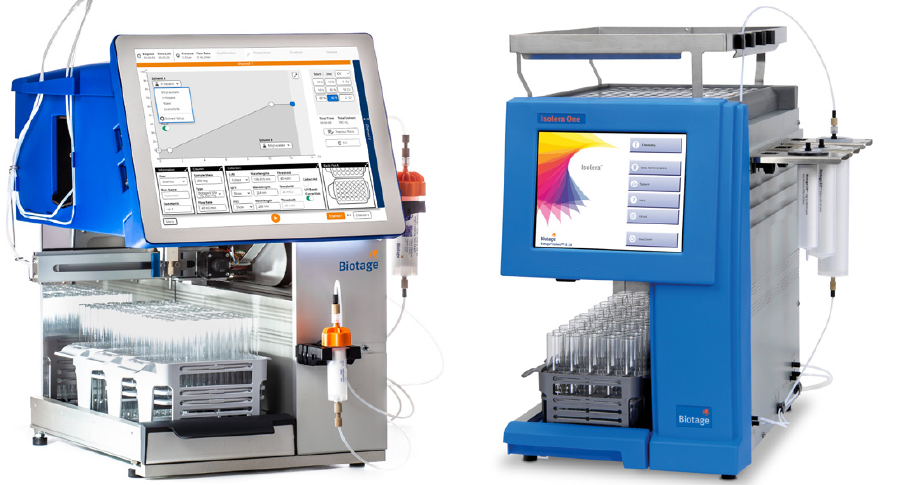
Figure 2: Biotage® Selekt flash purification system (left) and its predecessor, Isolera™ (right).
Li: Biotage is a well-established brand in the field of flash chromatography systems. I have been lucky enough to regularly use Biotage instruments since my undergraduate studies. I found the Isolera software very intuitive to learn and use, it was a great help from an educational perspective to learn method development, which I could translate to HPLC method development. The system was extremely robust and easy to maintain throughout the years. Selekt offers the same ease of use and robustness that I favour.
Is there anything you think Selekt does really well? Markus: It saves time, massive amounts of time. One of the most useful functions is gradient zero, which makes the detector incredibly sensitive even when solvent absorption is strong, like ethyl acetate which I frequently use. That lets me run separations with just tiny amounts of a compound bearing little or no real chromophore. Since I’m synthesizing lots of colourful molecules, the ability to collect only on specific wavelengths but still see the full spectrum at any time makes every separation a valuable source of information, especially since the spectra can be exported! What I also like very much is how fast the device can switch between reversed phase and normal phase because of the two-channel mode.
Li: It is useful in both large and small scale purifications. I had to run reversed phase purifications on large gram scales, and using the Selekt system was much easier and faster than doing it by hand, especially as mixing RP-gradients by hand can be very annoying. The UV detector is very sensitive, so even tiny amounts of product can be detected and collected by the fraction collector.
How do you think Selekt compares to other systems on the market?
Markus: There are not that many small compact flash systems on the market, and the Biotage Selekt seemed to be the best fit to us. Besides the already discussed functions, robustness is a big factor for us and the previous model seems to be very reliable. On top of that we get a system with Linux based software which is much more robust than a windows based one.
Li: Our main reasons to choose Biotage is very clear: it is robust, fast and easy to use. Other systems suffer from their Windows based OS, getting slower over time. I have bad experiences with modular systems that allow a lot of ‘personalization’ – which usually implies them breaking down much faster and being less robust. I think the solutions for sample loading with Selekt are more sophisticated than other brands, and the range of columns to choose from will allow heavy method optimization if needed.
Biotage would like to thank Markus Müller and Li Gao for taking part in this interview and sharing their thoughts of the Selekt automated flash purification system.
Literature number: PPS615
