

Figure 1: Scientists at the SGC-UNC site (from left to right): Alfredo Picado, PhD; Benjamin Eduful, PhD; Sean O’Byrne, PhD.
On a beautiful sunny day in Chapel Hill, North Carolina, we travelled to the University of North Carolina campus where we spoke with Dr. Alfredo Picado about how using our new Biotage® Sfär columns has impacted his time, output, and overall efficiency in his lab.
Dr. Picado works within the Structural Genomics Consortium (SGC), housed under the Eshelman School of Pharmacy at the University of North Carolina. Their team consists of chemists and biologists who all work under the SGC. We were able to discuss Dr. Picado’s most recent project at SGC and why Biotage columns made such an impact.
Can you tell us about your position and your background?
I’m originally from Costa Rica. I got my BS there and worked for about eight years. Then I went to Clemson University for graduate school in organic synthesis. During my graduate program I went to a GlaxoSmithKline site in Philadelphia for a year where I first came in contact with automated flash chromatography. I could have kissed that machine! I went back and finished at Clemson. After that, I taught at Pfeiffer University for a couple of semesters, then fortunately the position here at UNC opened and now I’m in my third year as a post-doc. Currently, I am also teaching organic chemistry at Campbell University in Fort Bragg
Can you describe your current area of research?
We just finished our poster on the synthesis of small molecule kinase inhibitor. DRAK2/STK17B (DAPK-related apoptosis- inducing protein kinase 2) is an understudied protein that has been linked to autoimmune diseases such as multiple sclerosis and type 1 diabetes. We are currently developing a chemical probe (potent and selective inhibitor) to help elucidate the role of this kinase inhibitor in disease.
I’ve been told that you fell in love with our Sfär columns, how did that come about?
It really started with the Biotage webinar last December, “Inspiring Productivity with Modern Flash Chromatography”. I thought I knew chromatography until I listened to the webinar live. It changed my view on what I was doing in the lab completely. Bob Bickler, the host, said that a lot of organic chemists will put something on the column and expect magic to happen, and that’s what I was doing! He explained about step gradient separations and the advantages of Sfär columns. He showed graphs with neat resolutions and separations that helped me open my eyes and realize that there are better options out there. Then we got some samples of the columns.
Once you had the columns in hand, what did you realize about making the switch?
No doubt the loading capability was the first thing I noticed. I pretty much solid-load all of my compounds. I was having to serial-connect two columns before to get the same amount through that I can purify with one single Sfär column. I’m working through 150 compounds for a project, and was using at least two columns per compound. That’s a lot of solvent, columns, and money. But I’m eliminating all of that with the Sfär columns. This approach also eliminates a lot of the time put into each separation because this column gets me much cleaner products. I’m not running chromatography over and over again like I used to. I never knew when I took this job, I’d spend so much time performing chromatography.
Would you say that now your work efficiency and flow have changed since implementing the columns?
Well let me show you. Example 1 was run on a gravity column, and example 2 was run on Sfär 10 g 60 μm column (Figure 1). Within an hour it was clean and ready to move to the next step. These columns are awesome! We’re purifying around 50–200 mg on each column. I couldn’t believe it was this clean. Before we started using Sfär, the example 2 would’ve taken me three days of work to get it that clean. It was a no-brainer to switch to Sfär.
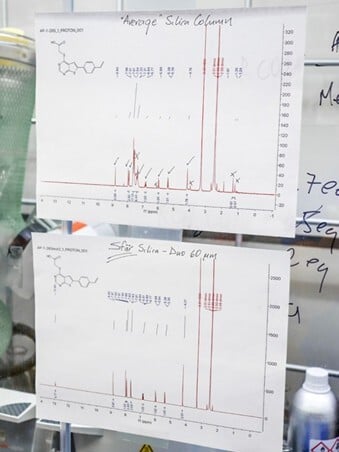
Figure 2: The result of the chromatography column test run still hangs on the fume hood in Dr. Picado’s lab.
What is next on your wish list to enable further efficiency gains and general success with your research projects?
For me I think about my future in science. One day I’d like to be a PI and I plan to ensure that my students know chromatography so they’re not spending more time than needed on the separation. Time is money and these columns save time and money.
It’s a false economy to think that just because another column is cheaper it’s better, that’s just not true. So to answer your question, my wish list is to have the purification pristine and that means using the Sfär columns.
The Structural Genomics Consortium
The Structural Genomics Consortium (SGC) is housed under the Eshelman School of Pharmacy at the University of North Carolina. Part of their mission is to become an open resource to create and share chemical probes for understudied proteins. On their platform...openlabnotebook.org
Literature number: PPS584
