
Introduction
Flash chromatography remains a cornerstone purification technique across pharmaceutical, academic, and industrial chemistry workflows due to its speed, scalability, and robustness.1 Performance in normal-phase chromatography depends heavily on the properties of the stationary phase, specifically particle morphology, packing homogeneity, and surface chemistry.2-4 Although silica is often treated as a commodity, variations in manufacturing processes between suppliers can meaningfully alter these characteristics.2,3 Chromatographic resolution is particularly sensitive to particle size distribution and column packing efficiency, both of which influence band broadening and overall separation quality.4,5 Additionally, variations in silica surface chemistry, including silanol activity and surface heterogeneity, can affect analyte interactions, altering selectivity, retention, and peak shape, particularly for polar compounds.3 Despite these known relationships, the practical impact of supplier-to-supplier variability on real-world flash separations is not always fully appreciated.
This study compares the performance of Biotage® Rening™ silica columns with two comparable external vendor columns using both a defined mixture of standard compounds and a representative synthetic isomer mixture. These comparisons were designed to evaluate differences in resolution, selectivity, and overall chromatographic efficiency under standardized flash chromatography conditions. Understanding how subtle differences in stationary phase properties translate into real chromatographic outcomes is essential for chemists seeking reproducible, high-quality purifications. Even minor variations in silica characteristics can influence separation success, solvent consumption, and purification efficiency.4,5 By systematically evaluating commercially available media, this work highlights how column choice can directly impact routine purification workflows and overall chromatographic performance.
Experimental
Materials
Standard test mix
A mixture containing 500 mg each of naphthalene, 3,5-Dibenzyloxyacetophenone, methyl-hydroxybenzoate was dissolved in 3 mL acetone.
Synthetic isomer mixture
A mixture of 500 mg each of m-,o-,p-nitroaniline was prepared in DCM simulating a reaction mixture of isomeric products. Naphthalene was added to identify and normalize column volumes for each column.
Flash Chromatography
All purifications were performed on a Biotage® Selekt Enkel automated flash chromatography system using default flow rates. The columns (Biotage® Rening™ Silica 5g, External vendor A: RediSep® Silver Silica 4g, External vendor B: FlashPure EcoFlex Silica 4g) were equilibrated for a minimum of two column volumes. A 1% w/w liquid sample load was used for all runs.
-
Standard mixture: isocratic 20% ethyl acetate in hexanes over 12 column volumes.
-
Synthetic Isomer mixture: isocratic 30% ethyl acetate in hexanes over 12 column volumes.
Resolution and efficiency for the standard mixture were calculated between adjacent peaks. For the synthetic isomer mixture, resolution was calculated between each isomer peak using the equations below, where t_Ris retention time and w_bis peak width at baseline.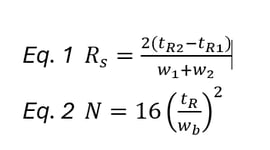
Results & discussion
Column performance with standard test mixture
Flash chromatography performance is influenced by the combined effects of retention, selectivity, and column efficiency. Under identical loading, equilibration, flow, and solvent conditions, the three silica columns produced noticeably different chromatographic profiles, indicating that supplier-specific differences in silica media and packed-bed characteristics can affect practical separation outcomes. The standard mixture provided a controlled comparison of retention behavior, peak width, calculated efficiency, and resolution across the evaluated columns.
All three columns separated the standard mixture; but peak broadening and resolution varied (Figure 1). The Biotage® Rening™ 5 g column showed the highest calculated efficiency for 3,5-dibenzyloxyacetophenone and the best resolution for methyl 4-hydroxybenzoate, (Table 1). External Vendor A produced similar resolution for the first analyte pair but lower calculated efficiency. External Vendor B showed reduced resolution for both separations. and incomplete baseline separation for 3,5-dibenzyloxyacetophenone limited direct comparison of its calculated efficiency.
These results indicate that, even when columns appear comparable, differences in packed-bed performance can affect peak shape and analyte spacing. In routine purification workflows, these differences can affect sample loading, fraction collection confidence, and whether a single purification run is sufficient.
Table 1: Calculated chromatography parameters using volume for time domain. Resolution (R) and Efficiency (N) were calculated using equations 1 and 2. *Reported efficiency for External Vendor B is skewed because baseline resolution was not achieved.

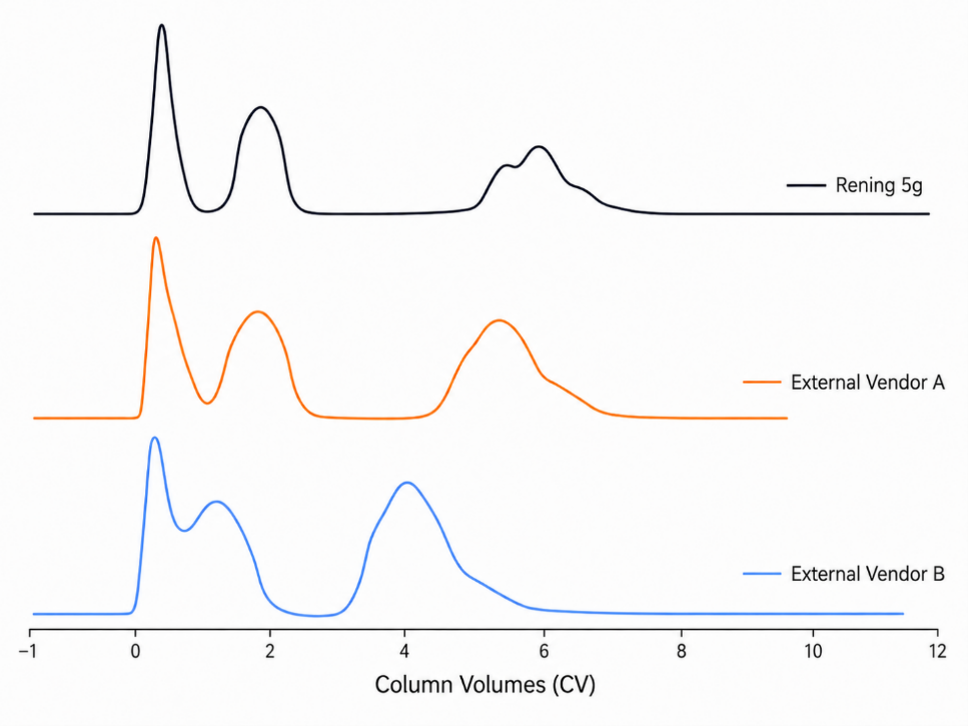 Figure 1: Flash chromatograms comparing the Biotage® Rening™ 5g silica to external vendors using standard mix.
Column performance with synthetic isomer mixture
The synthetic isomer mixture presented a more challenging separation model because the analytes are structurally similar and rely more heavily on subtle differences in selectivity, band broadening, and column efficiency. The Biotage® Rening™ 5 g column maintained clear separation across all nitroaniline peaks and provided measurable resolution between adjacent components, (Figure 2). External Vendor A also separated the mixture, but showed altered retention and broader peak profiles for late-eluting components when normalized to column volume. External Vendor B produced narrower peak widths for some components, but failed to achieve baseline resolution for the first nitroaniline peak, preventing calculation of resolution and efficiency for that component, (Table 2).
This comparison underscores the importance of evaluating columns using both simple standards and structurally related analyte mixtures. While a standard mixture reveals general chromatographic behavior, the synthetic isomer mixture more closely reflects real-world purification challenges where consistent peak definition and usable resolution are more important than any single efficiency value.
Table 2: Calculated chromatography parameters using volume for time domain. Resolution (R) and Efficiency (N) were calculated using equations 1 and 2. R and N were not calculated for peak 1 for External Vendor B as an achievable baseline or reasonable Wb could not be attained.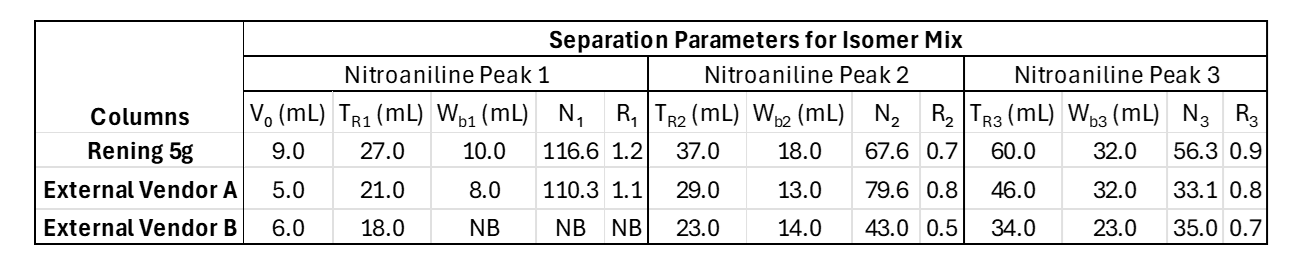
 Figure 2: Flash chromatograms comparing Biotage® Rening™ 5g silica to external vendors using isomer mix.
Conclusion
This study demonstrates that normal-phase flash silica columns from different suppliers can produce distinct chromatographic outcomes under identical method conditions. Across both the standard mixture and nitroaniline synthetic isomer mixture, variations in retention, peak width, efficiency, and resolution were observed, confirming that silica columns are not fully interchangeable consumables.
The Biotage® Rening™ 5 g column delivered consistent separation across both test systems and maintained practical resolution in the more challenging synthetic isomer mixture. These results support the use of this column for routine small-molecule purification workflows where reproducibility, confident fraction collection, and reliable separation of closely related compounds are important. For synthetic chemists, these findings highlight that column selection can directly influence purification success, solvent consumption, and the likelihood of needing repeat purifications. Selecting a column with reliable packed-bed performance and consistent resolution can improve workflow efficiency and increase confidence in product quality.
References
- Still, W. C.; Kahn, M.; Mitra, A. Rapid Chromatographic Technique for Preparative Separations with Moderate Resolution. J. Org. Chem. 1978, 43 (14), 2923–2925. https://doi.org/10.1021/jo00408a041.
- Snyder, L. R. Classification of the Solvent Properties of Common Liquids. J. Chromatogr. A 1974, 92, 223–230. https://doi.org/10.1016/S0021-9673(00)85732-5.
- McCalley, D. V. The Role of Silanol Groups in Liquid Chromatography. J. Chromatogr. A 2003, 1000 (1–2), 409–430. https://doi.org/10.1016/S0021-9673(03)00515-5.
- Neue, U. D. Theory of Peak Broadening in Chromatography. HPLC Columns: Theory, Technology, and Practice; Wiley-VCH: New York, 1997; pp 137–186.
- Guiochon, G. Preparative Liquid Chromatography. J. Chromatogr. A 2002, 965 (1–2), 129–161. https://doi.org/10.1016/S0021-9673(02)00649-4.
- Gritti, F.; Guiochon, G. Mass Transfer Kinetics, Band Broadening, and Column Efficiency in Modern Liquid Chromatography. J. Chromatogr. A 2012, 1221, 2–40. https://doi.org/10.1016/j.chroma.2011.06.078.
- Poole, C. F. Thin-Layer Chromatography and Preparative Layer Chromatography. J. Chromatogr. A 2003, 1000 (1–2), 963–984. https://doi.org/10.1016/S0021-9673(03)00558-1.
Literature number: AN1029
