
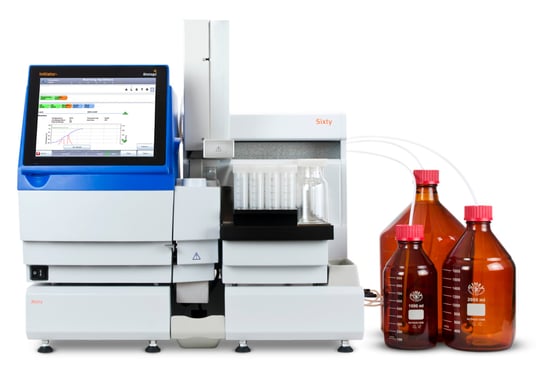
This application note demonstrates a variable scale synthesis on the Biotage® Initiator+ Alstra™ using the ACP (65–74) fragment as a model peptide.
Introduction
The ability to synthesize peptides in a range of different scales is a requirement in many research laboratories. The Biotage® Initiator+ Alstra™ fully automated microwave peptide synthesizer has a scale range of 5 μmol up to 2 mmol using three different reactor vial sizes (5 mL, 10 mL and 30 mL). The acyl carrier protein fragment, ACP (65–74), H-Val-Gln-Ala-Ala-Ile-Asp-Tyr-Ile-Asn-Gly-NH2 (VQAAIDYING-NH2) (1), is a well-known so-called difficult sequence and is commonly used to evaluate the performance of new synthesis reagents and instrumentation.
Here we demonstrate a variable scale synthesis on the Initiator+ Alstra™ using the ACP (65–74) fragment as a model peptide.
Experimental
Materials
All materials were obtained from commercial suppliers; Sigma-Aldrich (Diisopropyl carbodiimide (DIC), piperidine, trifluoroacetic acid (TFA), triisopropylsilane (TIS), formic acid and Rink amide AM polystyrene resin, 1.1 mmol/g)), Iris Biotech GmbH (Fmoc-amino acids), Fisher Scientific (NMP, DMF, diethyl ether and acetonitrile) and Novabiochem, Merck Millipore (Oxyma Pure and Rink amide AM polystyrene resin, 0.79 mmol/g). Milli-Q (Merck Millipore) water was used for LC-MS analysis. Nα-9-fluorenylmethoxycarbonyl (Fmoc) amino acids contained the following side-chain protecting groups: Asn(Trt), Asp(OtBu), Gln(Trt), Tyr(tBu).
Peptide Synthesis and Analysis
Nα‑Fmoc deprotection was performed at room temperature (RT) in two stages by treating the resin with 20% piperidine/ NMP for 3 min followed by 20% piperidine/NMP for 10 min. The resin was then washed with NMP (4 x). The peptides were synthesized using Nα-Fmoc amino acids (3.0 eq., 0.5 M for 0.25 mmol scale and 3.0 eq., 0.7 M for 2 mmol scale), employing one of the following coupling protocols:
- 0.25 mmol scale - DIC (3.0 eq., 0.5 M),
Oxyma Pure (3.0 eq., 0.5 M) in NMP - 2.0 mmol scale - DIC (3.0 eq., neat),
Oxyma Pure (3.0 eq., 4.5 M) in NMP
All couplings used microwave irradiation and were performed at 75 °C. After each coupling step, the resin was washed with NMP (4 ×).
For the 2 mmol scale synthesis a pause step was programmed in the synthesis after the coupling of the penultimate Gln residue to enable a small sample of the resin to be removed and checked by ninhydrin test, as it is known to be problematic. The ninhydrin test was slightly positive (some blue beads were observed), and therefore an additional Gln coupling step was programmed at this point “on-the-fly” and the synthesis continued until completion.
After the synthesis of the peptide sequence and final Nα‑Fmoc deprotection was completed, the resin was successively washed with NMP (3 ×), DCM (2 ×) and dried thoroughly. The peptides were cleaved from the solid support by treatment with TFA-TIS-H2O (95:2.5:2.5) for 2 hours. The resin was separated by filtration and the cleavage cocktail was collected. The peptide was isolated by precipitation with cold diethyl ether (3 ×). The peptide was dissolved in 20% acetonitrile/water (the acetonitrile was added first), washed with DCM (2 x) and freeze dried to afford the product as a white powder. Analytical HPLC was performed on an Agilent 1100. The peptide was analyzed on a Resolux 200 Å C18 column (4.5 μm, 150 × 2.1 mm) with a flow rate of 1.0 mL/min. The following solvent system was used: solvent A, water containing 0.1% formic acid; solvent B, acetonitrile containing 0.1% formic acid. The column was eluted using a linear gradient from 0% buffer B to 90% buffer B over 20 min. Identification was carried out by ESI-MS (Agilent Technologies 6120 Qudropole LC/MS).
|
Scale (mmol) |
Vial size |
Resin |
Loading (mmol/g) |
Crude Purity (%) |
|
0.25 |
10ml |
Rink amide AM polystyrene |
1.1 |
97% |
|
2.0 |
30 ml |
Rink amide AM polystyrene |
0.79 |
91% |
.png?width=1304&height=469&name=biotage-an068-figure1-RP-HPLC-chromatogram-ESI-MS-2mmol-scale-synthesis-ACP%20(65-74).png) Figure 1: RP-HPLC chromatogram and ESI-MS of 2 mmol scale synthesis of ACP (65-74) (1).
Figure 1: RP-HPLC chromatogram and ESI-MS of 2 mmol scale synthesis of ACP (65-74) (1).
Results & discussion
The ACP (65–74) peptide (1) was successfully synthesized using microwave irradiation at different scales with a crude purity of 97% (0.25 mmol scale) and 91% (2.0 mmol scale) (Figure 1) and confirmed by ESI-MS (Figure 1), calculated average isotopic composition for C47H75N13O15, 1061.55 Da. Found: m/z 1062.50 [M+H]+.
Conclusion
The ACP (65–74) peptide (1) was successfully synthesized in 2 mmol scale on a Biotage® Initiator+ Alstra™ fully automated microwave peptide synthesizer using standard pre-installed methods to afford the desired peptide in excellent crude
purity.
We have demonstrated the advantages of using a robot liquid handler to dispense concentrated reagents which allows a lower excess of activated amino acids to be used, which is problematic for systems using nitrogen assisted valve based dispensing of reagents. With increasingly viscous reaction mixtures, mixing is an even more important factor at elevated temperatures for homogeneous heat distribution especially at larger scales, but this was overcome by the use of the highly effective oscillating mixer which enabled 5 min coupling times at 75 °C. In addition, the very flexible and intuitive software platform allowed various synthesis scales to be programmed effortlessly and the changing of a method “on-the-fly”.
Literature Number: AN068
