
Summary
Solid phase extraction (SPE) is a commonly used method to clean up various types of samples before analyzing them using LCMS. It is also an effective way to improve the purity of crude synthetic peptide samples, which significantly reduces the time required to deliver compounds for evaluation. Additionally, this method reduces solvent consumption by over 90% compared to standard sequential HPLC purification, which achieves purities typically not required for secondary screening assays. Importantly, peptide clean up methodologies utilizing SPE in a 96-well format can be automated, allowing large numbers of samples to be processed in parallel and complementing high throughput peptide synthesis methodologies commonly employed. Taken together, these features make SPE an excellent technique for purifying peptide libraries.
However, to achieve these benefits, it is essential to select a media in the well plate that interacts predictably with the peptide samples – eluting in high yield with a single mobile phase treatment, thereby eliminating the need to analyze every sample prior to the cleanup process and every fraction generated therein. Biotage has developed the PeptiRen-96 C18 well plate for peptide library cleanup. In this study, we show that using Biotage® PeptiRen C18 media results in significantly improved purity of crude samples in a predictable manner compared to other commercially available media.
Introduction
The development of unbiased screening technologies has increased the range of peptides that can be screened efficiently in early lead identification programs, making them more attractive for drug discovery pipelines. Once hit compounds are identified, validation and preliminary structure-activity relation- ships are assessed using synthetically produced compounds. To minimize reagent consumption and time invested in peptide families, these compounds are typically synthesized on a very small scale and in very high throughput.
Automated peptide synthesis platforms enable the preparation of hundreds of compounds simultaneously, but purification strategies are still largely sequential. HPLC purification, which is standard for larger research-scale synthetic compounds, becomes a bottleneck and wastes both time and solvents during high throughput library synthesis efforts. Moreover, downstream assays do not typically require HPLC-grade purity levels for compound evaluation. A potential alternative strategy to HPLC purification is solid phase extraction (SPE) which enables parallel sample handling and has historically been demonstrated to improve purity of complex sample mixtures.
This technology is attractive for synthetic peptide library clean up in parallel, if chromatographic behavior can be readily predicted and then recapitulated. However, selecting the right media is crucial in solid-phase extraction (SPE) to maximize the effectiveness of the cleanup process. The media serves as the stationary phase in SPE, where it selectively interacts with the target compound while excluding unwanted contaminants. Poorly chosen SPE media may not interact selectively with the target peptides or may interact with other crude sample components, leading to poor purification efficiency, low sample recovery, or co-elution of intolerable impurities in the final sample.
Preliminary efforts1 have demonstrated that reversed phase media yields the most predictable behavior for peptide libraries containing a wide range of physiochemical properties. However, commercially available reversed phase media used for traditional SPE applications are manufactured with a variety of particle parameters that could impact the elution predictability and sample recovery desired for synthetic chemists. Similar to the manner in which an HPLC column is chosen – wherein different particle parameters are recommended for different sized peptides - reversed phase media needs to be evaluated for SPE applications as well. In this work, we compare several commercially available reversed phase. In this work we compare several commercially available reversed phase SPE media using both purified and crude peptide samples to identify the most amenable media for peptide library cleanup.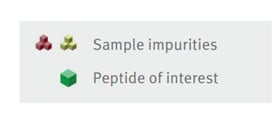
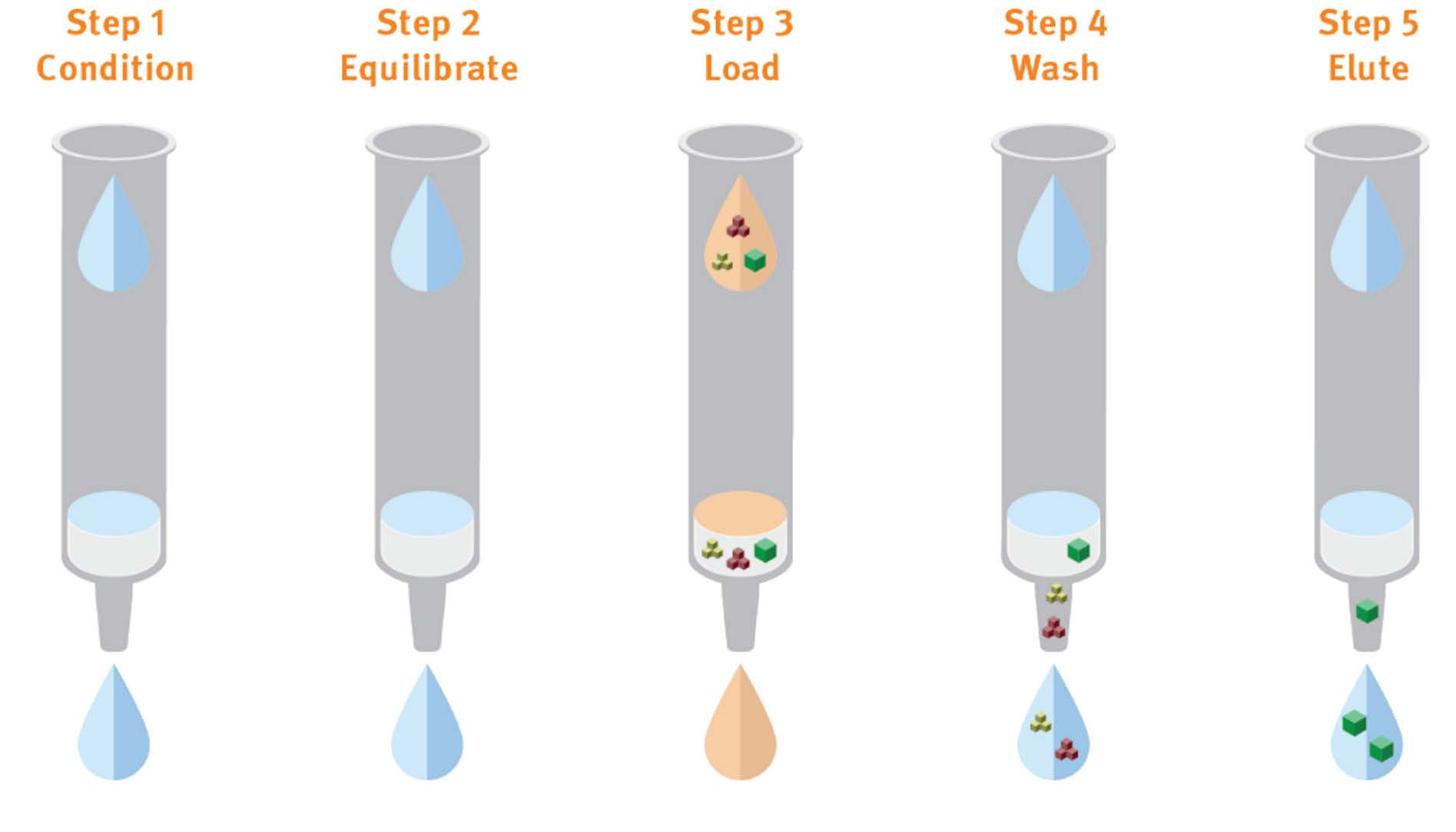 Figure 1. Graphical representation for general SPE sample handling steps.
Methods
The peptide of interest was synthesized using standard Fmoc-based chemistry with a Biotage® Initiator+ Alstra™ or Biotage® Syro II peptide synthesizer then cleaved using a solution of 96:2.5:2.5 TFA:H2O:TIS stirred for 3 hours. The filtered peptidyl solution was then evaporated directly using the Biotage® V-10 Touch Evaporation system. The crude peptide was then purified using a Biotage® Selekt flash purification system equipped with a Biotage® Sfär® Bio C18 column and purity deter- mined via analytical HPLC using an Agilent 1260 Infinity series HPLC equipped with Restek ARC18 column (2.7 µm particles,
2.1 x 50 mm) connected in-line with an Advion®expression® CMS mass detector.
The peptide was then dissolved in DMSO and prepared for loading in 0.5%, 1%, and 2% quantities (w/w) relative to sorbent mass for comparison of SPE media using the Biotage® Extrahera™ automated sample preparation workstation. Generally, 96-well plates containing an SPE media of interest was conditioned with 3 bed volumes (μL/mg) 100% acetonitrile (ACN) + 0.1% TFA, then equilibrated with 3 bed volumes 10% ACN(aq) + 0.1% TFA, prior to loading the sample onto the media in 0.6 bed volumes. The media was then re-equilibrated with 3 bed volumes 10% ACN(aq) + 0.1% TFA, washed with 3 bed volumes of 65% ACN(aq) + 0.1% TFA to elute the desired peptides, then washed with 3 bed volumes of 70% ACN(aq) + 0.1% TFA to confirm complete elution of the desired peptide from the media. In a final step, the media was treated with ACN + 0.1% TFA to elute any residual sample contents. Each “fraction” was collected, evaporated using a Biotage® SPEDry 96 to dryness, reconstituted in methanol and evaluated for content by analytical HPLC as described above.
Experimental design
Sorbents selected for evaluation
Media parameters – particle and pore size specifically – impact purification efficiency regardless of the purification strategy employed. This is readily demonstrated by column choices made for flow-based purification methods. For example, previous work has demonstrated that reversed phase media with wide pores provides greater resolution for peptides when used in low pressure purification systems. Alternatively, media utilized in SPE methodologies are inherently designed to retain small molecules, like drugs of abuse, while excluding other biological matrix components like proteins, peptides, and lipids. This design feature could become a liability when the media is considered for alternative applications though, specifi- cally those involving peptides.
Table 1 shows the three commercially available C18 reversed- phase media types selected for this study to assess the impact of these physical parameters for SPE-type clean-up of synthetic peptide samples.
|
|
PeptiRen C18 |
Wide-pore C18 |
“Standard” end-capped SPE C18 |
|
Particle size, μm |
30 |
20 |
50 |
|
Pore size, Å |
100 |
300 |
60 |
|
Bed mass, mg |
500 |
500 |
100 |
|
Sample load: 18mer, mg (μmol) |
2 (0.91), 5 (2.27), 10 (4.54) |
2 (0.91), 5 (2.27), 10 (4.54) |
0.5 (0.23), 1 (0.45), 2 (0.91) |
Table 1. Comparison of sorbents used for peptide cleanup.
Peptides selected for sorbent evaluation
While this technology has been tested on several peptides with differing physical properties (number of amino acids for example), the peptide highlighted in this comparison is shown in Table 2. This sequence was chosen primarily due to its similarity with those currently under evaluation for therapeutic applications. It is critical to compare these media using a range of peptides as this enables assignment of observed elution behavior differences to generic properties of the media, rather than the specific sequences evaluated.
|
|
18 Amino Acids, linear |
|
Sequence |
H-DWLKAFYDKVAEKLQEAF-NH2 |
|
Molecular Weight |
2200.49 |
|
Net Charge (pH 7, 2) |
0, +4 |
|
Isoelectric Point |
7.01 |
|
Average hydrophobicity |
0.22 |
|
HPLC Retention Time |
6.01 min |
|
Calculated Acetonitrile Elution |
60.1% |
Table 2. Physiochemical characteristics of the peptides selected for this evaluation. HPLC retention time and corresponding ACN concentration required for elution determined using a 2%B to 90%B gradient running over 9 minutes.
Comparison of reversed phase SPE media performance
In SPE, achieving elution behavior that closely aligns with the predicted behavior from traditional high-performance liquid chromatography (HPLC) is of utmost importance for reliable method development. The elution behavior of analytes in SPE determines their separation and extraction efficiency, making it a critical factor in the success and reproducibility of the method. When the elution behavior in SPE closely matches the predicted (or observed) HPLC behavior, it ensures that the target peptides are effectively retained and subsequently eluted from the solid-phase sorbent, leading to accurate and consistent results. This alignment facilitates method transfer- ability, allowing researchers to confidently translate their established HPLC methods into robust SPE protocols, enabling reliable crude peptide purity improvements and analysis across different analytical platforms.
In order to apply this strategy to plate-based peptide libraries, the peptide(s) should be released completely from the media using a concentration slightly greater than that required to elute from a reversed phase C18 media, as predicted either experimentally or theoretically2-5 . Not only does this behavior minimize subsequent handling steps (evaporating then combining multiple volumes all containing a single peptide), but it also eliminates the need for extensive analytical workup to locate the desired peptide sample from multiple potential collection plates.
In this proof-of-concept experiment, the purified 18 amino acid peptide sample was applied to the various SPE plates used in this study in 0.5%, 1%, or 2% (w/w) quantities relative to media bed mass, after the media had been conditioned and equilibrated. Then, each reversed phase media was treated with 65% ACN(aq), a concentration slightly greater than the determined elution conditions, to release the bound peptide from the media. To characterize the elution efficiency, or ability to elute the sample fully in a single treatment, the media were subsequently treated with 70% ACN(aq) and those fractions evaluated for peptide content.
Results and discussion
PeptiRen media provides highest yields and predictive correlation
For the purified peptide evaluated, complete sample recovery in the desired 65% ACN(aq) treatment fraction was only achieved when the sample was applied to Biotage® PeptiRen C18 media. Figure 2. Representative chromatogram highlighting elution predictability and consistency for an 18 amino acid peptide relative to the starting sample material. Sample volumes injected for analysis were adjusted to enable monitoring of sample recovery.
Importantly, this behavior was consistent across multiple replicates in different regions of the sorbent plate, and this also remained consistent as the sample load increased Figure 2.
When the same peptide was applied to the traditional SPE C18 media and wide pore C18 media, a measurable percentage of the total sample content remained bound and was eventu- ally eluted with the 70% ACN(aq) wash step Figure 3. For all peptides evaluated here and not shown, the amount of peptide collected in the 70% ACN(aq) wash actually increased with increasing sample load, compromising the final recovery of the desired compound and limiting the utility of this technique for synthetic peptide libraries with these two media.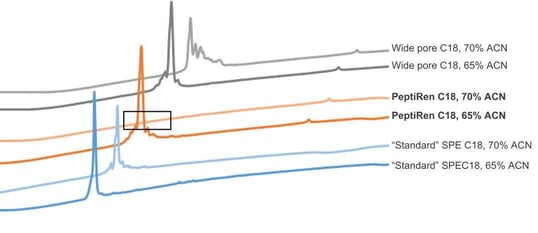 Figure 3. Representative comparison of elution efficiency of the 18-amino acid peptide loaded onto each of the three reversed phase media types evaluated. Only Biotage® PeptiRen C18 media enables complete elution of the desired sample in a single mobile phase treatment (dark blue trace).
The presence of the desired peptide in the 70% ACN treatment fraction suggests that the binding affinity between the sample and the sorbent was of mixed strength, leading to incomplete elution during the first step. However, the Biotage® PeptiRen C18 media exhibited no additional elution at a higher concentration, demonstrating optimal mass transfer kinetics for the interaction of the sample with the media and validating the prediction that media parameters should be evaluated to determine compound compatibility. This outcome highlights the efficiency of Biotage® PeptiRen C18 in completely releasing the target peptides from the solid-phase sorbent, and thereby ensuring optimal recovery, eliminating the need for additional elution steps.
Improving purity of a crude peptide sample with PeptiRen media
With this information in hand, the media comparison was repeated for the crude 18 amino acid peptide sample Figure 4.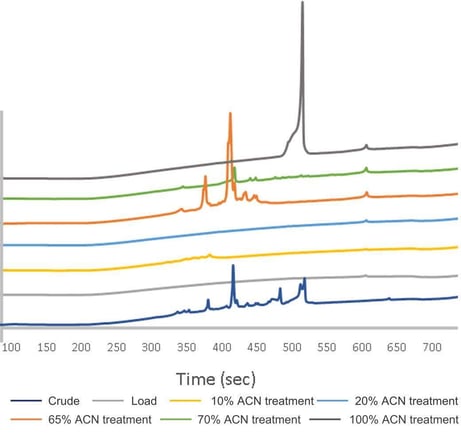 Figure 4. Representative crude 18mer sample clean up using Biotage® PeptiRen C18. The desired compound elutes completely in the desired 65% ACN fraction as expected. Sample purity improves from ~21% crude purity to ~55% pure after treatment with minimal synthesis optimization.
The crude sample was not subjected to an ether precipitation step upon completion of the cleavage reaction, leaving behind released protecting groups and cocktail scavengers in the sample. Eliminating the ether precipitation step is considered during peptide library synthesis due to the practical limitations of employing this strategy in plate-based syntheses. While this is outside the traditional research-scale solid phase synthesis workflows, ether precipitation adds significant handling difficulties for plate-based synthetic peptide libraries. The residual contaminants, however, can have disastrous effects on downstream assay results and need to be removed. Given the significant chromatographic differences between peptides and the residual protecting groups, SPE technology can quickly remove these contaminants.
As with the purified peptide sample, complete recovery of the desired crude 18 amino acid peptide was only achieved using the Biotage® PeptiRen C18 reversed phase media. The presence of additional sample components did not appear to affect the previously observed elution efficiency and the diligent ACN wash concentration selection enabled removal of some additional peptidic, but slightly later eluting, impurities in the sample.
Importantly though, the residual protecting groups are NOT eluted from any media type until a final 100% ACN treatment. This finding indicates that the residual protecting groups can still be removed from even relatively hydrophobic peptide libraries, eliminating the need to perform ether precipitation when synthesizing plate-based peptide libraries – a very cumbersome step at very small scale. And when the cleanup is performed with the Biotage® PeptiRen C18 media, the sample is expected to be contained in this one single fraction, minimizing the demand for follow up analytical characterization.
Conclusion
Among the media tested, Biotage® PeptiRen C18 stood out as the only media that exhibited behavior in line with the predicted results, demonstrating its compatibility with synthetic peptide SPE-based clean up. The fact that Biotage® PeptiRen C18 showed no further sample elution confirmed that all the sample had been successfully eluted during the initial step, highlighting its efficiency in capturing and releasing peptides. On the other hand, the unpredictable binding affinity observed with the other two plates suggests that employing them in peptide purifi- cation could pose challenges in terms of sample recovery. Their tendency to exhibit incomplete elution implies that these plates may not be as effective in capturing and releasing peptides, potentially leading to reduced yields and compromised purifica- tion results. Thus, Biotage® PeptiRen C18 emerges as the most reliable choice for peptide library clean up due to its consistent and predictable elution behavior.
References
- Bennett,R. et al; Analytical Chimica Acta, 2021, 1142, 10-18.
- Muroz, L.; Käll, L.; Mass Spectrometry Reviews, 2016, 36, 615-623.
- Bouwmeester, R.; et al; Nat Methods 2021, 18, 1363-1369.
- Guo, D.; Mant, C.; Taneja, A.; Hodges, R.; J. Chrom. A, 2001, 359, 519-532.
- Samuelsson, J.; et al; J. Chrom. A, 2019, 1598, 92-100.
Literature Number: AN987
