
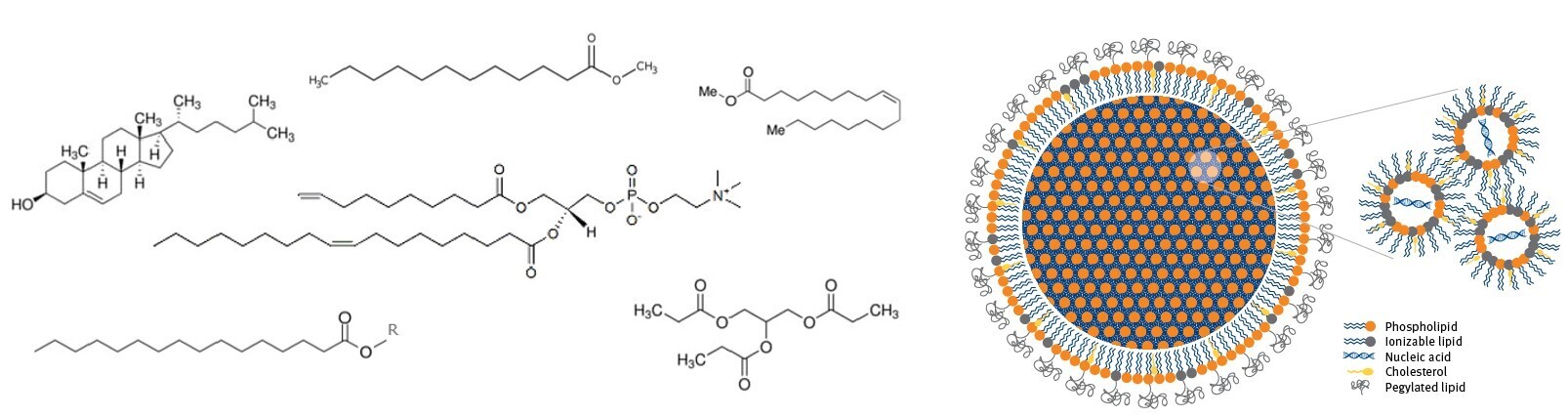
 COVID-19 triggered accelerated research into vaccine development. Some of the vaccines are based on mRNA which, if not protected, easily degrades in humans before its therapeutic benefits can be realized. To protect the mRNA and enable its effectiveness, pharmaceutical companies worked with biotechnology companies to create more viable cell delivery options. The most widely used is lipid nanoparticle (LNP) encapsulation. This exciting technology uses microfluidics to combine the vaccine, lipids, other excipients and adjuvants into small spherical particles called LNPs. Each lipid in an LNP has its own function and thus is contributing to the overall therapeutic effect (Table 1).
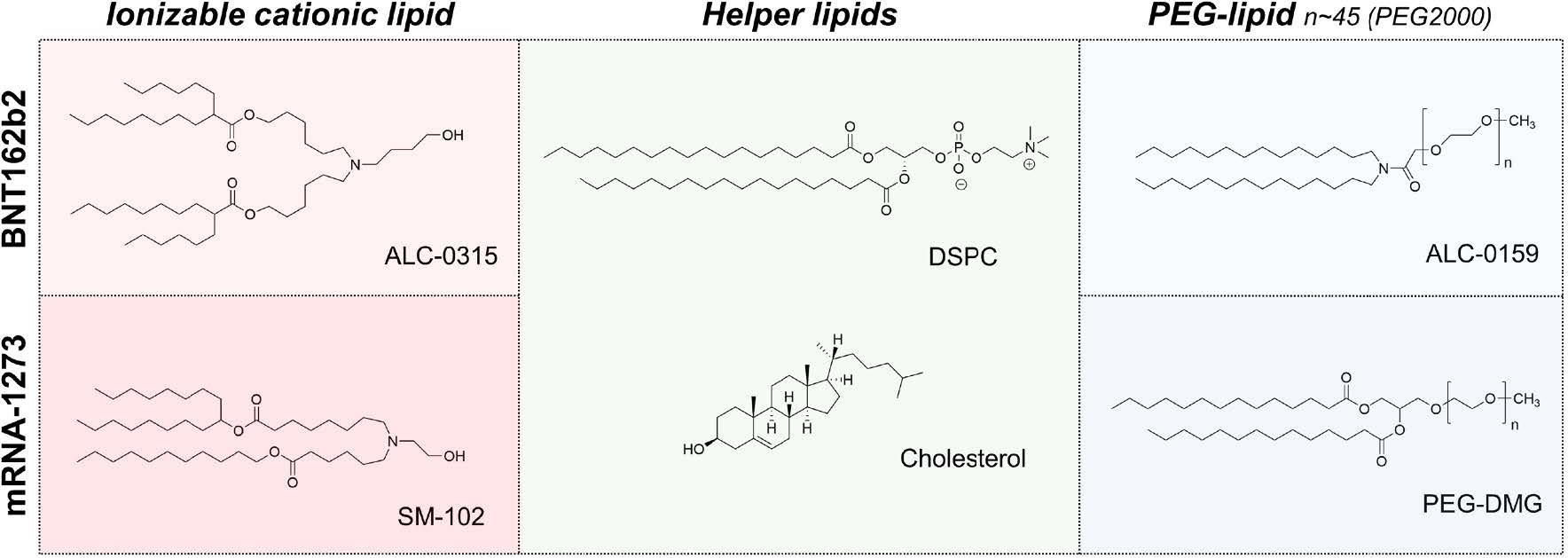 Table 1. Lipids used in the mRNA-LNP COVID-19 vaccines BNT162b2 (Comirnaty) and mRNA-1273 (image from mRNA-lipid nanoparticle COVID-19 vaccines: Structure and stability, Linde Schoenmaker, Dominik Witzigmann, Jayesh A. Kulkarni, Rein Verbeke, Gideon Kersten, Wim Jiskoot, Daan J.A. Crommelin, International Journal of Pharmaceutics, 601 (2021) 120586)1.
Lipid mixtures used in LNPs typically contain one cationic, one PEG-based, a phospholipid and a lipid that is neutral, such as cholesterol. Due to the chemical nature of these molecules, many purification techniques such as distillation or crystalliza- tion are either extremely difficult to implement or impractical to do so, and so the industry faced a new challenge at scale.
Luckily, lipids tend to be well suited to off-the-shelf purifica- tion methods and platforms, such as Biotage automated flash chromatography research and development systems (Biotage® Selekt, Biotage® Isolera LS) and scale up platforms (such as Biotage® Flash 400) for rapid purification – using both normal- phase and reversed-phase chromatographic methods. This application note shows how a variety of different lipids may be purified using flash chromatography.
For some small molecules, specifically lipids, there has been a reticence to use regular flash purification (i.e. with simple UV monitoring) as lipids don’t often have a strong enough chromophore to be detectable by simple UV monitoring systems. In those cases, often ELSD is the ‘go to’ detection mode, but ELSD can be difficult to implement when increasing scale (flow rates) and sometimes therefore more tricky to use by production operatives. However, the use of lambda all features on advanced detectors in modern automated flash purification systems, such as Biotage® Selekt or Biotage® Isolera LS , which sum responses from all wavelengths, thereby amplifying the chromophoric signal has helped chemists find optimal elution times and points for target compounds within their mixtures without the need of further or more complex technology.
We applied this feature to a small test suite of lipids using a 60 micron spherical silica stationary phase (SFAR 60) in a 10g flash cartridge with a typical normal mobile phase. The test mix shows that flash techniques can be applied to our particular structurally diverse mixture of lipids and it was interesting to see that, due to their chemical structure and separation properties, some of our lipids could be used in either normal- or reversed-phase purification strategies.
Our 3 component text mix comprised of various lipids in a mixture (71%, 12% and 17% by composition) and baseline separation with the DOPC was possible to obtain after minimal method development and optimization. It was the lambda all that enabled the development, once a method is determined, it can then be transferred to larger scale (Table 2). Figure 1. Normal-phase flash chromatographic purification of methyl palmitate and cholesterol. The fully saturated palmitate is too lipophilic to be retained on the normal phase stationary phase, while cholesterol, with its hydroxyl group, is well retained, and elutes later in the run.
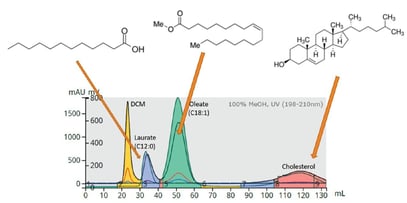 Figure 2. Reversed-phase flash chromatography purification of methyl laurate, methyl oleate, and cholesterol in 100% methanol with UV (198–210 nm). This example shows the application of ELSD detection. These lipids are easily detected by both UV and ELSD including the fully saturated methyl laurate.
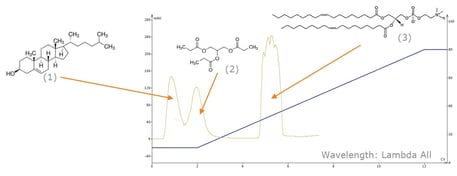 Figure 3. Normal phase flash chromatography purification of Cholesterol, Tripropionin, DOPC in hexane / ethanol showing the effect of powerful lambda all.
|
|
Biotage® Selekt |
IsoleraTM LS |
Biotage® Flash 150 |
Biotage® Flash 400 |
|
Column Size |
5–350 g |
20-2000 g |
2.5–6.5 Kg |
20–50 Kg |
|
Typical Max Sample Size per Run |
35 g |
200g |
500 g |
4 Kg |
|
Part Number Options |
SEL-2EW |
ISO-ILSW |
SF-022-25071 |
SF-521-50070 |
|
|
SEL-2SW |
SF-022-25071 |
SF-521-50150 |
Table 2. Typical scale up path, using Biotage laboratory systems from research and development through to process orientated self-contained purification skids such as Flash 400.
Scaling up flash purification
Due to the already proven scalable nature of flash purification (Figure 4), purification strategies involving multiple platforms, using the same stationary phase, (such as the Biotage® SFAR 60) for lipids can be developed and further optimized, then applied to multi-Kg scale purification campaigns. Large-scale production skids such as Biotage® Flash 400, utilizing columns that may contain 40–50Kg of stationary phase can separate many Kg of lipid mixtures. Such conditions make scaling up to isolate Kg of target compound in one run, a reality.
Sophisticated laboratory scale and development systems such as Isolera LS have advanced method editors and optimization tools to enable creation of more efficient step or isocratic gradients for process scale, depending on the elution / system.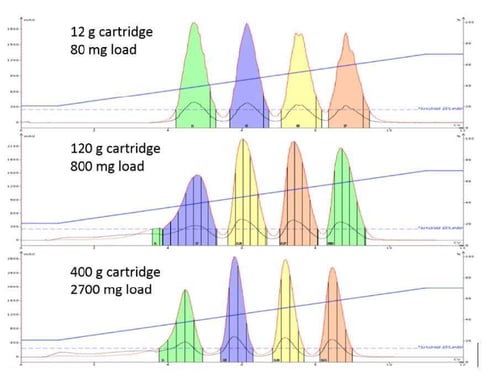 Figure 4. An example of scale up theory. If a 10g development cartridge has a scale factor of 1, then a 50 g cartridge has a factor of 5, a 400 g cartridge has a scale factor of 40 and thus a 40 Kg cartridge has a factor of 4000. Using the same stationary phase in our development, we have identical chemical selectivity and retention on scale up, meaning predictable compound elution. Therefore, small scale is seamlessly transferred to large multi-Kg scale.
Experimental procedure
- Lipids: Cholesterol (MW 386), Tripropionin (MW 260), DOPC (MW 786)
- Mobile Phase
- A: Hexane (0.02% Acetic Acid)
- B: Ethanol (0.02% Acetic Acid)
- Gradient / conditions
- 10% B- 3CV
- 10–80% - 10 CV
- 80% - 1CV
- Stationary Phase / Column
- Biotage® SFAR Silica 10g - 60µm, [p/n FSRS-0445-0010]
- Standard Injection
- 100 mg DOPC, 75mg Tripropionin, 25mg Cholesterol (200 mg total) in 2mL
- Sample Load
- 0.5 mL load of 100mg/mL , 0.5% load.
Conclusion
Flash chromatography is a viable technique for the purification of lipids. In our tests we saw excellent separation in the case of both normal or reversed phase purification runs, depending on the lipid chemical structure. Using advanced detection features such as lambda all, weakly chromophoric lipids such as DOPC were be detected and isolated and consistency of stationary phase meant that on scale up, we would be able to rapidly archive predictable target compound elution from our sample mixtures.
References
- mRNA-lipid nanoparticle COVID-19 vaccines: Structure and stability, Linde Schoenmaker, Dominik Witzigmann, Jayesh A. Kulkarni, Rein Verbeke, Gideon Kersten, Wim Jiskoot, Daan J.A. Crommelin International Journal of Pharmaceutics, 601 (2021) 120586.
Literature Number: AN977
