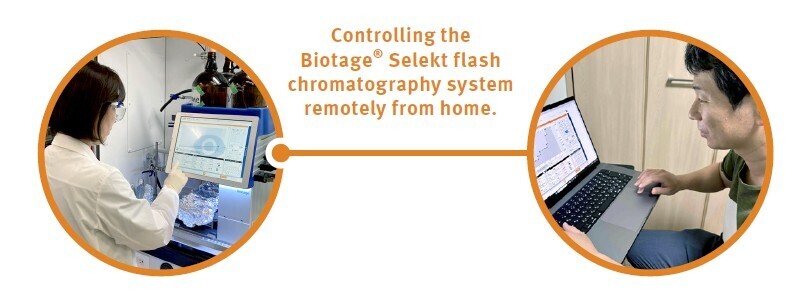
 A materials science laboratory in Japan uses remote control capabilities in their flash chromatography processes to enhance problem-solving and reduce the risk of miscommunication. This functionality also enables remote guidance and support for research team members through the software.
Dr. Hironobu Hayashi, Senior Researcher at the Nanoprobe Group, Center for Basic Research on Materials, National Institute for Materials Science (NIMS), Japan, explains how the Biotage® Selekt automated flash purification system and its Biotage® Selekt Remote Control functionality are streamlining their purification process by enabling efficient remote operations.
Could you share more details about the activities of your research group?
Dr. Hayashi: Our laboratory specializes in organic synthesis, focusing on molecules that can be used in semiconductor materials, porous organic materials, their polymers and
two-dimensional nanosheets. We use Biotage® Selekt to purify these molecules after organic synthesis reactions.
What types of organic compounds are you purifying?
Dr. Hayashi: I can't go into too many details, but most of the compounds are polycyclic aromatic hydrocarbons with numerous benzene rings. Their molecular weights range from 200-600 in general but can sometimes be as high 3000.
Polycyclic compounds with large molecular weights are typically difficult to purify. How does this compare to the group of compounds you are working with?
Dr. Hayashi: This type of molecules is certainly difficult to handle, as many of them have poor solubility. However, by optimizing our sample loading methods and elution conditions, we have been able to purify them successfully.
When did you first become acquainted with the Biotage® Selekt and its remote technology functionality?
Dr. Hayashi: During my postdoctoral work at the University of Geneva, Switzerland, our lab used an earlier generation purification system, the Biotage® Isolera™. I did not have access to such equipment as an undergraduate and I was impressed by its speed when I first used it. When I returned to Japan as an Assistant Professor, I found that our lab had a Biotage® Isolera™, but almost nobody was using it, so I promoted its use and its popularity increased among researchers. As demand grew and waiting times extended, we decided to invest in the latest model, the Biotage® Selekt, with its speed of purification being the decisive factor.
We then transferred the system to NIMS, where a salesperson from Biotage Japan introduced me to the Biotage® Selekt Remote Control functionality. I had always been interested in remote operation for purification processes. Given that this transition coincided with my move from the university to NIMS, I decided to install these upgrades to create my ideal research environment. The remote functionality was also ideal for providing operational support and training to the researchers.
Before using automated flash purification systems, what was your main method of purification?
Dr. Hayashi: I used to do manual purification by packing silica gel and solvents into glass columns myself. During my post-doc, although we had the Biotage® Isolera, it was the only system available, so I had to combine it with manual column chromatography. Manual columns were time-consuming and required continuous attention. Given the strong desire for quicker purification, I had no qualms about adding more automated purification equipment.
Did you also introduce the remote functionality at that time?
Dr. Hayashi: Yes! Before we added the Biotage® Selekt Remote Control functionality, we could not begin a purification process right before a meeting and had to wait until we could monitor the process by the system. In addition, when students or support staff had questions about the process, we had to go in front of the Biotage® Selekt system and explain it to them, so it was sometimes difficult to give advice during meetings or business trips. We felt that this was inefficient.
It was inconvenient from an educational point of view that we could not give advice or operate the system unless we were on-site. It was also unsatisfactory that we could not check the purification status from our research offices.
After introducing the Biotage® Selekt Remote Control functionality, the process has become much more efficient in every aspect. For example, the purification status can now be checked and operated remotely while waiting for the nuclear magnetic resonance (NMR) analysis. Additionally, when students or support staff face issues, we can give advice directly on the screen, even while travelling. Previously, instructions were mainly given via phone or PC, and sometimes they were not conveyed properly. Now I can operate the system remotely, if necessary, which is very convenient.
Also, as I am raising a young child and sometimes need to leave the workplace on short notice to handle sudden illnesses or other emergencies, it was previously difficult to respond before or during the purification process. Since I can now operate the system remotely from home, the problem has been resolved. I think the hurdles in the purification process have been significantly reduced, and the functionality has been well-received by fellow staff and students.
 What do you think of the possibilities for the remote functionality in the future?
Dr. Hayashi: It is easier to carry out joint research projects with students from other universities. Since we will handle the sample loading, we would like the students to use the remote functionality to purify their own compounds, for example when investigating optimal separation conditions.
Who would you recommend the Biotage® Selekt and the remote functionality?
Dr. Hayashi: The key advantage of the Biotage® Selekt is its exceptional purification speed. When I first recommended the system to a student, he replied that manual columns were faster and chose not to use the system. The student was indeed excellent, and his efficiency was impressive even without an automated system. However, once he had the opportunity to use the system and experience the purification speed, he was hooked onto it. For the students I supervised who graduated this year, the Biotage® Selekt became their go-to purification tool.
Introducing Biotage® Selekt Remote Control is beneficial in many ways, allowing students and support staff to monitor and control the process from any location. In universities, it is valuable for graduate students and assistants to use it as a teaching tool for undergraduate students.
Literature Number: PPS755
