
Acrylamide extraction and analysis can be difficult. The primary challenge is balancing efficient extraction from a complex matrix with effective removal of background interferences before analysis, without risking analyte loss. Sometimes, there are instances in testing where you’re looking for a simple, yet “good enough” clean-up for acrylamide extracts. One option is ISOLUTE® SLE+. SLE stands for Supported Liquid Extraction. This technique is a simple and effective solution for removal of matrix interferences from acrylamide extracts prior to analysis.
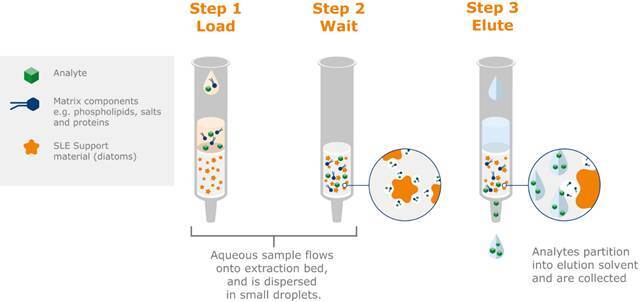
Figure 1: Overview of the SLE steps.
In Figure 1, you can see that analytes and matrices are loaded onto the column containing the SLE+ support material. After the sample is loaded into the SLE+ media, a wait step allows the sample to absorb into the media. Finally, an organic solvent is applied to elute the analytes of interest from the column.
This SLE+ process is analogous to traditional liquid-liquid extraction (LLE) because it still utilizes the same water immiscible solvents for analyte extraction. However, instead of shaking the two immiscible phases together as in LLE. With SLE, the aqueous sample is immobilized on an inert support (i.e. the SLE+ media bed in the cartridge), and the organic phase flows through the support. Since the aqueous and non-aqueous solvents are not vigorously mixed, it eliminates the chances of emulsions and low analyte recovery.
The SLE+ approach is an alternative to the classic and more robust 2-step clean-up. Based on the simple SLE+ process of 'Load-Wait-Elute', sufficient sample clean-up can be achieved, allowing quantification of acrylamide in many matrices. Clean-up of acrylamide extracts is required in order to effectively analyze the extracts. Depending on the complexity of your sample and detection levels, you may be able to simplify the 2-step SPE approach using a SLE+ clean-up.
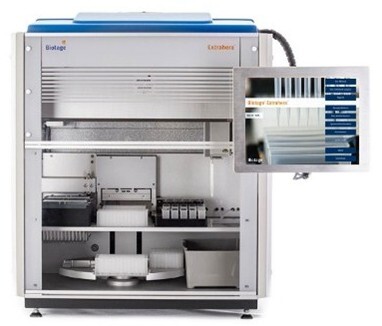
The initial work conducted in the application note below was completed manually, however, it can be easily automated using the Biotage® ExtraheraTM Classic, enabling higher throughput and improved reproducibility. The brief process of how the samples were processed for acrylamide analysis is as follows:
Method overview
Sample pre-treatment:
- Coffee: Prepared in water with a basic buffer added.
- Potato chips: Finely crushed and extracted with water.
- Internal standard added.
ISOLUTE® SLE+ clean-up:
- Aqueous sample extract is applied to the SLE column (Load) and allowed to absorb into the media (Wait).
- Extraction solvent (ethyl acetate/THF (50/50, v/v)) is applied to the column (Elute) and allowed to flow under gravity. Extracts are collected. A second aliquot is added, and this step is repeated.
- After evaporation of the extraction solvent, the extract is analyzed by LC-MS/MS.
Take a look at the full application note below for more details on acrylamide extraction from coffee and potato chips!
